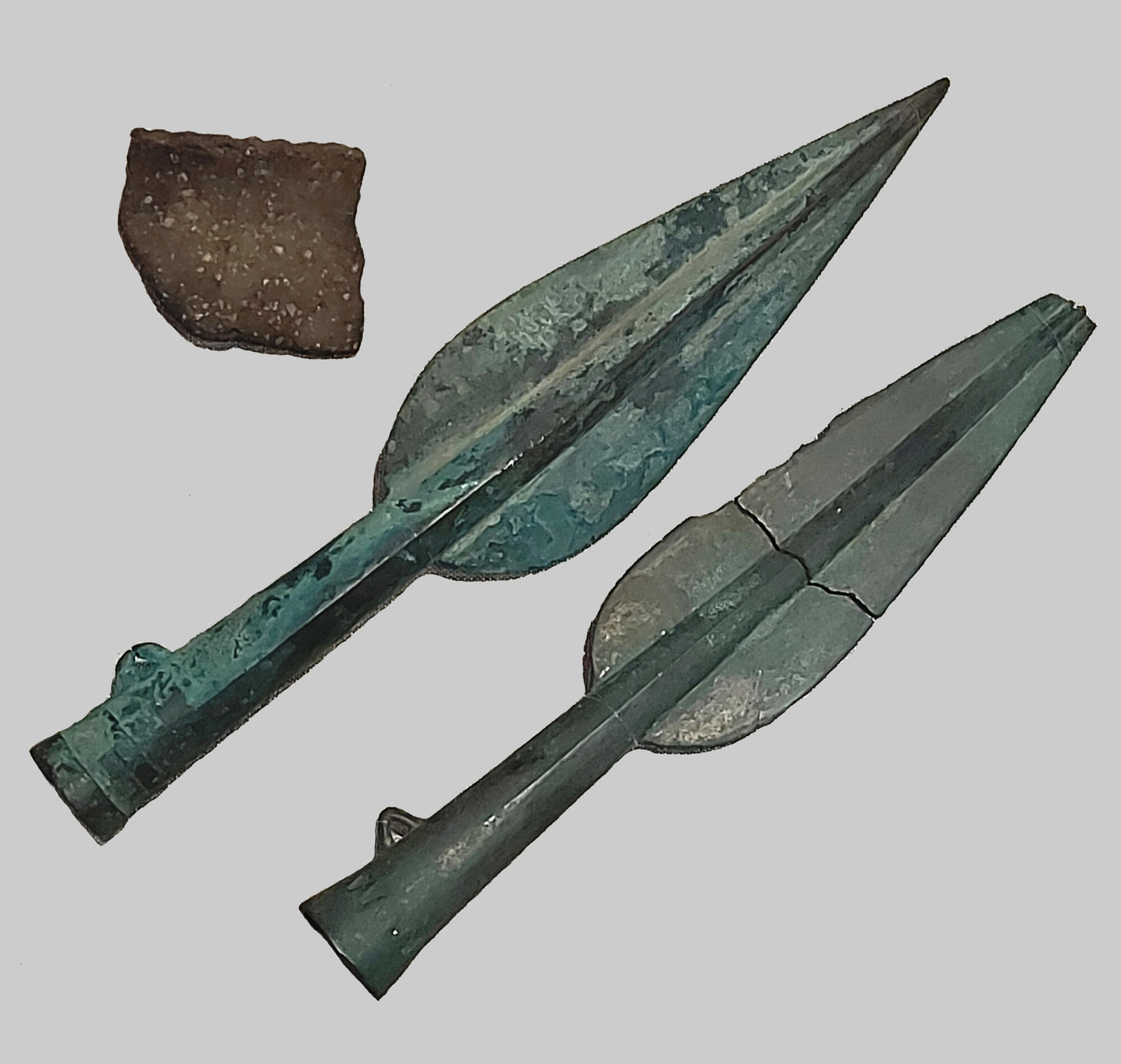


In the middle of the second millennium BCE, compact groups of the Trans-Urals population entered the forest belt, armed with spears with bronze tips and daggers. Separated from the ore deposits needed to replenish the weapons, the newly-arrived population quickly dispersed among the forest tribes. This population has had a great influence on the formation of metallurgy and metalworking in the local population of the forest belt. At the Belozera site in the area of KargUlino, archaeologists discovered two bronze spears and a saw knife from a set of SEyminsk-TUrbin weapons.
The SEyminsk-TUrbin (the more accurate modern name is the transcultural Seyminsk-Turbin phenomenon) culture was spread in the Late Bronze Age in North Eurasia from the Sayano-Altai region, the territories of Mongolia and Xin-Jiang to Fennoskandia and Moldavia. Vasily GorotsOv, Aleksander Spitsyn, Arne Talgren, Otto Bader and other scientists explored this culture over the years. The tombs of the Seyma, Turbino and Rostovka are considered to be the key monuments of the Seyminsk-Turbin culture. The main feature of this culture is the developed form of bronze weapons: spearheads, Celtic axes, daggers with handles in the form of figurines of horses, bulls, elks, snakes and other animals. They were produced with thin-walled casting techniques. The development and widespread use of such casting was a technological leap in metalworking in North Eurasia.
Scientists have also discovered so-called altar memorials - metal tools, weapons, stone arrowheads laid out in the ground at a low depth. Remains of human graves were very rare. The images on daggers and petroglyphs in the foothills of Altai, Tien Shan, in Xinjiang proved that this culture used cattle breeding and a domesticated horse in their households, while the images on a dagger from RostOvka and ‘masks of priests’ from the Galich Treasure demonstrated that this culture representatives had Mongoloid traits.
The spread of the Seyminsk-Turbin culture adjoined the Dzungarian Gates. The inhabitants of these regions were eventually joined by groups of forest hunters and fishermen from the basin of Upper Yenisey and the Baikal region. Hunters and fishermen used flint and bone arrow point, bone-based insert knives.
The SEyminsk-TUrbin (the more accurate modern name is the transcultural Seyminsk-Turbin phenomenon) culture was spread in the Late Bronze Age in North Eurasia from the Sayano-Altai region, the territories of Mongolia and Xin-Jiang to Fennoskandia and Moldavia. Vasily GorotsOv, Aleksander Spitsyn, Arne Talgren, Otto Bader and other scientists explored this culture over the years. The tombs of the Seyma, Turbino and Rostovka are considered to be the key monuments of the Seyminsk-Turbin culture. The main feature of this culture is the developed form of bronze weapons: spearheads, Celtic axes, daggers with handles in the form of figurines of horses, bulls, elks, snakes and other animals. They were produced with thin-walled casting techniques. The development and widespread use of such casting was a technological leap in metalworking in North Eurasia.
Scientists have also discovered so-called altar memorials - metal tools, weapons, stone arrowheads laid out in the ground at a low depth. Remains of human graves were very rare. The images on daggers and petroglyphs in the foothills of Altai, Tien Shan, in Xinjiang proved that this culture used cattle breeding and a domesticated horse in their households, while the images on a dagger from RostOvka and ‘masks of priests’ from the Galich Treasure demonstrated that this culture representatives had Mongoloid traits.
The spread of the Seyminsk-Turbin culture adjoined the Dzungarian Gates. The inhabitants of these regions were eventually joined by groups of forest hunters and fishermen from the basin of Upper Yenisey and the Baikal region. Hunters and fishermen used flint and bone arrow point, bone-based insert knives.