In pre-Mongol Russia, encolpion crosses were widespread. They were folding pectoral crosses with a small container where a shrine could be kept warding off evil spirits. This could be a relic of a saint, crumbs of a prosphoron, or a pinch of holy soil. Typically, encolpia were worn over the clothes.
Wearing these crosses with amulets was associated with Byzantine traditions that were brought to Russia. A cross was given to a believer during the sacrament of Baptism. Each baptized Christian was supposed to carry their cross throughout their earthly life. Encolpia were treated as valuable relics, treasured, carefully preserved, passed down to descendants, and sometimes donated to churches. It was not only a sacred but also a very expensive object.
Most of the pre-Mongol encolpia were inspired by Byzantine and South Russian artifacts of the 11th–13th centuries. Encolpia featured figures of saints. In the early Byzantine period, there were also images of paradise birds and pious wishes. For example, paired gold enamel-painted crosses could be inscribed with words “light” and “life”.
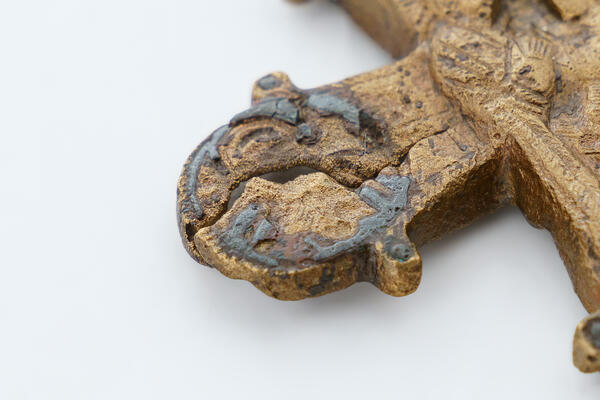
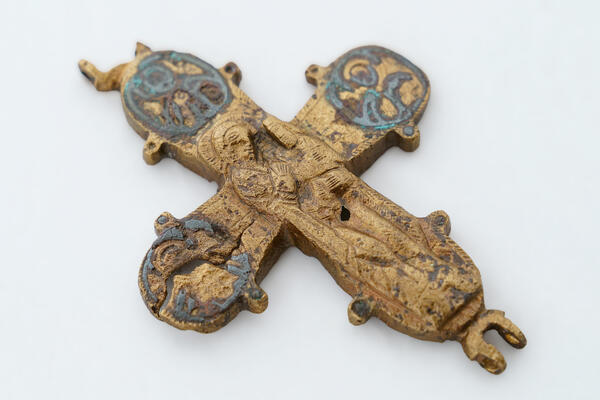
The panel of the encolpion with Virgin Hodegetria (Kupyatitskaya icon) from the collection of the Andrei Rublev Museum dates back to the 11th–12th centuries. It was a copper-cast double-panel cross that was usually worn around the neck on a string chain. At the top and bottom ends, there are attachments in the shape of double loops.
The Kupyatitskaya icon of the Virgin Mary was named after a miracle that took place in a forest near the village of Kupyatichi (now in the Pinsk district of the Brest Oblast, Belarus). Legend has it that a six-year-old shepherd girl noticed a shining copper cross hung from a tree branch. On one side of the cross, there was a depiction of the Crucifixion of Jesus, and on the other side, the Virgin Mary holding the Christ Child. During the 17th–18th centuries, the Kupyatitskaya icon was one of the major relics in Kiev, and it was kept at the ancient St. Sophia Cathedral.
The Byzantine influence is evident in the design of
the four-sided panel with right angles of the crossing point and rounded ends.
On the sides and at the top, there are half-length images of saints in round
medallions. Only the outlines of the figures have been preserved. This lack of
detail makes it difficult to determine the identity of the saints. This is a
common problem with copper-cast encolpia, as the reliefs quickly wore off due
to frequent usage.