A graphic artist and painter, book designer and teacher, Alexander Sergeyevich Bakulevsky was a People’s Artist of Russia, an Honored Artist of the RSFSR, an Honored Artist of the Mari ASSR and a member of the Artists’ Union of Russia. He was rightfully considered one of the most authoritative masters of book and print graphics, to which he dedicated his entire life. He participated in many All-Union, All-Russian and international competitions and became a recipient of many awards. His works are kept in the Tretyakov Gallery, in the Pushkin Museum in Moscow, and in other art museums in Russia and abroad. 50 prints are kept in the Albertina Museum of World Graphics (Vienna).
Alexander Bakulevsky graduated from the Kazan Art College, and after serving in the army — the department of book graphics of the Graphic Faculty of the Repin State Institute of Painting, Sculpture and Architecture. Bakulevsky’s main job after returning to his small homeland was working in a publishing house. He created illustrations for Sergei Chavain’s book, for Mari folk tales, the Mari epic “Yugorno” and other Mari-themed works. The artist painted portraits of heroes of labor, tried his hand at making watercolors and linoprints, carried out commissions from the Art Fund and publishing houses “Children’s Literature”, “Soviet Russia”, and “Rainbow”.
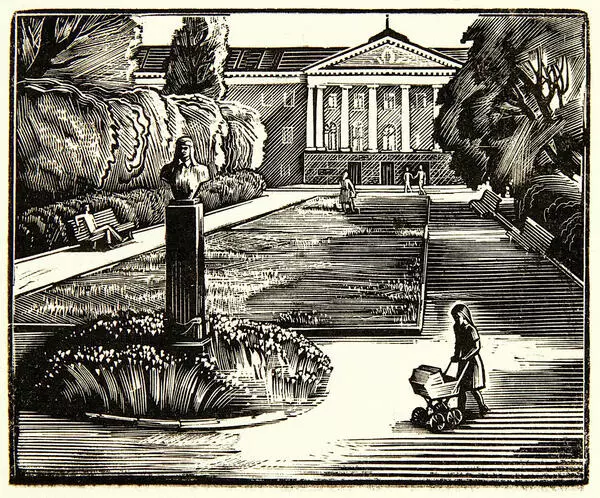
Alexander Bakulevsky was a master of woodcut. This technique was used to illustrate “The Tales of the Late Ivan Petrovich Belkin” by Alexander Pushkin, and “The Story of the Chevalier des Grieux and Manon Lescaut” by Antoine François Prévost. Bakulevsky also used this technique for the illustrations to the works by the poets of the Silver Age Innokenty Annensky, Anna Akhmatova, Boris Pasternak, and Marina Tsvetaeva. In addition, he was responsible for the miniature editions of the works of Mikhail Lermontov, Nikolai Gogol, Fyodor Dostoevsky, Leo Tolstoy, and Anton Chekhov, as well as a unique handmade book — the novel “The Master and Margarita” by Mikhail Bulgakov.
The works by Alexander Sergeyevich Pushkin had a special significance for the artist, as they inspired him to create the most famous and the best graphic works in his collection. For the development of the Pushkin theme in the visual arts, he was awarded the golden Medal of Pushkin.
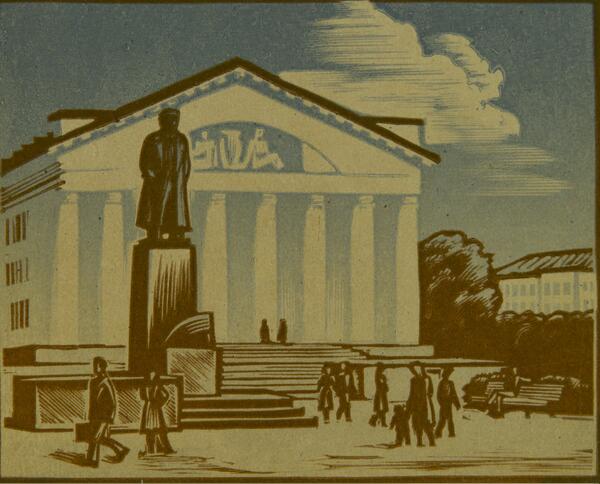
The series “Yoshkar-Ola” (1981–1982) is dedicated to the memorable places of the capital of Mari El. Bakulevsky’s sheets made in the classic technique of color woodcut are distinguished by an exceptional skill and a high quality of graphics. The combination of a bluish-white building against a darker sky with curly tree tops on the right looks exquisite.
Alexander Bakulevsky graduated from the Kazan Art College, and after serving in the army — the department of book graphics of the Graphic Faculty of the Repin State Institute of Painting, Sculpture and Architecture. Bakulevsky’s main job after returning to his small homeland was working in a publishing house. He created illustrations for Sergei Chavain’s book, for Mari folk tales, the Mari epic “Yugorno” and other Mari-themed works. The artist painted portraits of heroes of labor, tried his hand at making watercolors and linoprints, carried out commissions from the Art Fund and publishing houses “Children’s Literature”, “Soviet Russia”, and “Rainbow”.
Alexander Bakulevsky was a master of woodcut. This technique was used to illustrate “The Tales of the Late Ivan Petrovich Belkin” by Alexander Pushkin, and “The Story of the Chevalier des Grieux and Manon Lescaut” by Antoine François Prévost. Bakulevsky also used this technique for the illustrations to the works by the poets of the Silver Age Innokenty Annensky, Anna Akhmatova, Boris Pasternak, and Marina Tsvetaeva. In addition, he was responsible for the miniature editions of the works of Mikhail Lermontov, Nikolai Gogol, Fyodor Dostoevsky, Leo Tolstoy, and Anton Chekhov, as well as a unique handmade book — the novel “The Master and Margarita” by Mikhail Bulgakov.
The works by Alexander Sergeyevich Pushkin had a special significance for the artist, as they inspired him to create the most famous and the best graphic works in his collection. For the development of the Pushkin theme in the visual arts, he was awarded the golden Medal of Pushkin.
The series “Yoshkar-Ola” (1981–1982) is dedicated to the memorable places of the capital of Mari El. Bakulevsky’s sheets made in the classic technique of color woodcut are distinguished by an exceptional skill and a high quality of graphics. The combination of a bluish-white building against a darker sky with curly tree tops on the right looks exquisite.