#1
Certificate of a Battleship Torpedoman & Zverev
#2
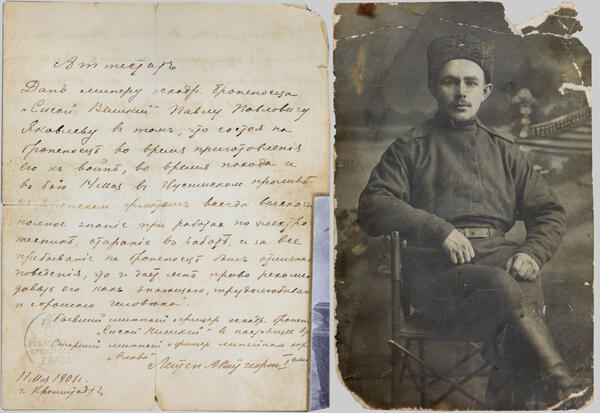
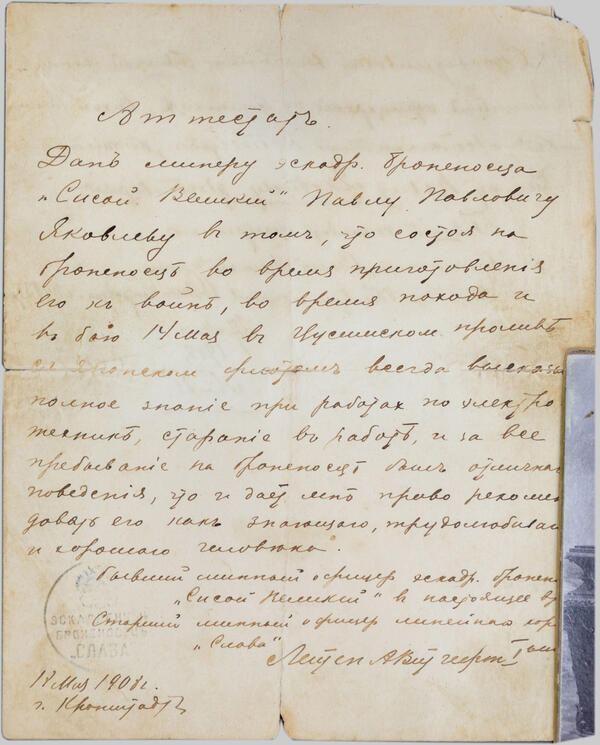
Certificate of Pavel Yakovlev, a Torpedoman Who Served on the Battleship 'Sissoi Veliky'
#8
#3
The certificate of a torpedoman on the battleship Sissoi Veliky in our exposition used to belong to Pavel Pavlovich Yakovlev. Born in Moscow in 1876, he was orphaned at a very early age and was brought up by his aunt. Pavel Yakovlev graduated elementary school and was bound apprentice to a small plant that produced churchware. There, he learned engraving, metalsmithing, and the basics of galvanization. After that, he graduated from the naval school for petty officers. The training process was very hard and demanding.
Pavel Yakovlev was appointed a torpedoman on the Sissoi Veliky battleship. Torpedomen were responsible for maintaining the ship’s weapons. The skills he gained at the plant came in handy during his service in the Navy. The Sissoi Veliky battleship was a part of the Second Pacific Squadron during the voyage to the Far East and participated in the Battle of Tsushima in the Sea of Japan. An attack of Japanese destroyers left the battleship seriously damaged. Pavel Yakovlev was among the last ones to leave the ship. He and another sailor were taken captive by the Japanese. And once again, the skills he had learned at the churchware factory proved to be useful. He weaved lace-like chainwork out of horse-hair, carved figurines of people and animals, and made engraved patterns. The Japanese were quick to purchase his inexpensive craftwork. The money he earned helped feed his fellow captives.
After the war, Pavel Yakovlev returned to Russia and continued to serve in the navy. Once discharged, he worked as a foreman at a power station. He was one of their best experts in electric motors. In the years of the Revolution and the Civil War, Pavel Yakovlev served in the Volga warship flotilla as a mining expert. He worked on ships and at power stations in the Russian south. Then he moved to Moscow with his family and worked as a foreman at an electromechanical plant until his retirement. During the Great Patriotic War, he continued to work toward helping his country.
Pavel Yakovlev was awarded the medal “For Defense of Moscow” and “For Brave Work During the Great Patriotic War of 1941–1945.” He was also keen on preserving his medal for participation in the Russo-Japanese War. The veteran of three wars passed away in 1959.
Pavel Yakovlev was appointed a torpedoman on the Sissoi Veliky battleship. Torpedomen were responsible for maintaining the ship’s weapons. The skills he gained at the plant came in handy during his service in the Navy. The Sissoi Veliky battleship was a part of the Second Pacific Squadron during the voyage to the Far East and participated in the Battle of Tsushima in the Sea of Japan. An attack of Japanese destroyers left the battleship seriously damaged. Pavel Yakovlev was among the last ones to leave the ship. He and another sailor were taken captive by the Japanese. And once again, the skills he had learned at the churchware factory proved to be useful. He weaved lace-like chainwork out of horse-hair, carved figurines of people and animals, and made engraved patterns. The Japanese were quick to purchase his inexpensive craftwork. The money he earned helped feed his fellow captives.
After the war, Pavel Yakovlev returned to Russia and continued to serve in the navy. Once discharged, he worked as a foreman at a power station. He was one of their best experts in electric motors. In the years of the Revolution and the Civil War, Pavel Yakovlev served in the Volga warship flotilla as a mining expert. He worked on ships and at power stations in the Russian south. Then he moved to Moscow with his family and worked as a foreman at an electromechanical plant until his retirement. During the Great Patriotic War, he continued to work toward helping his country.
Pavel Yakovlev was awarded the medal “For Defense of Moscow” and “For Brave Work During the Great Patriotic War of 1941–1945.” He was also keen on preserving his medal for participation in the Russo-Japanese War. The veteran of three wars passed away in 1959.
#7
Author: unknown
Date: 1901
Technique: paper, printing
Dimensions: 22×17,5 cm
Place: Russia
Collection: Documents
Copyright: Municipal Budget Institution of Culture “Mytishchi History and Art Museum”
Date: 1901
Technique: paper, printing
Dimensions: 22×17,5 cm
Place: Russia
Collection: Documents
Copyright: Municipal Budget Institution of Culture “Mytishchi History and Art Museum”
#4
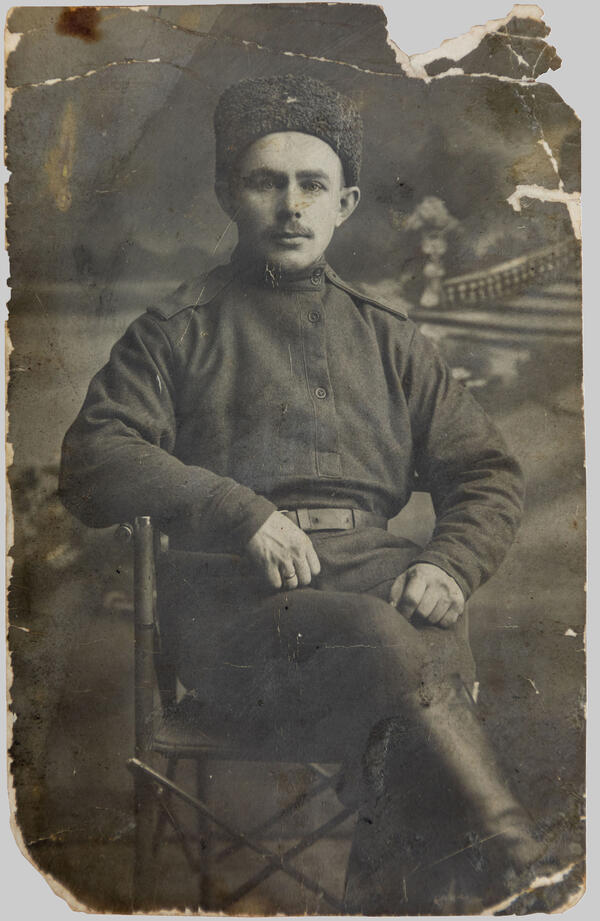
Ivan Aleksandrovich Zverev
#9
#5
World War One was one of the largest armed conflicts in human history. This war forever changed the course of history and reshaped the map of the world. At the time, it was called the Great War.
On August 1, 1914, Germany officially declared war on Russia. Marches and manifestations were held across the nation, and patriotism was on the rise among the people as the news of the upcoming war broke. Millions of soldiers were mobilized across the Russian Empire during the war. An estimated 1.7 to 2 million of them perished.
The first mobilization lasted two weeks and was successfully concluded. Young people aged between 22 and 26 were drafted from Bolshie Mytishchi. Papers reporting from the railroad terminals at the time admired the bravery and resolve of Russian soldiers who were ready to defend the Faith, the Tsar, and the Fatherland:
‘The day before the soldiers were shipped to war, a guiding prayer was held. Reserve soldiers have gotten back into the military order and no longer seem like weirdly acting civilian men in military uniforms. A crowd of several thousand people surrounded the corps. Women were crying and barely containing themselves from weeping loudly… they walked alongside their brothers and husbands on the sidewalk, carrying their bedrolls and duffels, chatting as much as they could before sending their loved ones on their way… The freight station was in perfect order… And when the train pulled away from the station, the orchestra at the platform blasted with “God, save the Tsar” (Russia’s Imperial anthem) — this was met with a thunderous ‘Hurrah! ’ from the train cars’.
The first wave of mobilization also spurred a widespread volunteer movement. The volunteers were called “okhotniki, ” and those were received ahead of everyone else at the recruiting stations. The “politically active” were not mobilized, but they could volunteer for service. This is why a prominent revolutionary Ivan Zverev, who was under police surveillance at the time, was able to arrive at the frontlines as a volunteer in 1915. From there on out, the only thing we know about him is that he went missing in action at the Bzura River in Poland. Tragic news from the frontlines was relayed to the regional government from the military office in Moscow, and the regional government then notified the next of kin of the deceased and missing soldiers.
In 1917, over the course of two revolutions, Bolsheviks came to power and signed a separate peace treaty in Brest. On March 3, 1918, Russia officially ceased hostilities.
On August 1, 1914, Germany officially declared war on Russia. Marches and manifestations were held across the nation, and patriotism was on the rise among the people as the news of the upcoming war broke. Millions of soldiers were mobilized across the Russian Empire during the war. An estimated 1.7 to 2 million of them perished.
The first mobilization lasted two weeks and was successfully concluded. Young people aged between 22 and 26 were drafted from Bolshie Mytishchi. Papers reporting from the railroad terminals at the time admired the bravery and resolve of Russian soldiers who were ready to defend the Faith, the Tsar, and the Fatherland:
‘The day before the soldiers were shipped to war, a guiding prayer was held. Reserve soldiers have gotten back into the military order and no longer seem like weirdly acting civilian men in military uniforms. A crowd of several thousand people surrounded the corps. Women were crying and barely containing themselves from weeping loudly… they walked alongside their brothers and husbands on the sidewalk, carrying their bedrolls and duffels, chatting as much as they could before sending their loved ones on their way… The freight station was in perfect order… And when the train pulled away from the station, the orchestra at the platform blasted with “God, save the Tsar” (Russia’s Imperial anthem) — this was met with a thunderous ‘Hurrah! ’ from the train cars’.
The first wave of mobilization also spurred a widespread volunteer movement. The volunteers were called “okhotniki, ” and those were received ahead of everyone else at the recruiting stations. The “politically active” were not mobilized, but they could volunteer for service. This is why a prominent revolutionary Ivan Zverev, who was under police surveillance at the time, was able to arrive at the frontlines as a volunteer in 1915. From there on out, the only thing we know about him is that he went missing in action at the Bzura River in Poland. Tragic news from the frontlines was relayed to the regional government from the military office in Moscow, and the regional government then notified the next of kin of the deceased and missing soldiers.
In 1917, over the course of two revolutions, Bolsheviks came to power and signed a separate peace treaty in Brest. On March 3, 1918, Russia officially ceased hostilities.
#6
Author: unknown
Date: 1914
Technique: paper, photo printing
Place: Russia
Dimensions: 13×8,5 cm
Collection: Film, photographs, and sound
Copyright: Municipal Budget Cultural Institution “Mytishchi History and Art Museum”
Date: 1914
Technique: paper, photo printing
Place: Russia
Dimensions: 13×8,5 cm
Collection: Film, photographs, and sound
Copyright: Municipal Budget Cultural Institution “Mytishchi History and Art Museum”
read morehide
00:00
00:00
1x
Certificate of a Battleship Torpedoman & Zverev
Collection
Exhibition
2
 Point your smartphone camera to open in the app
Open in app
Share