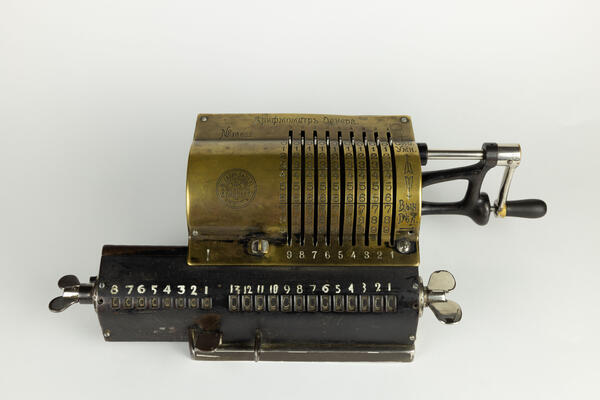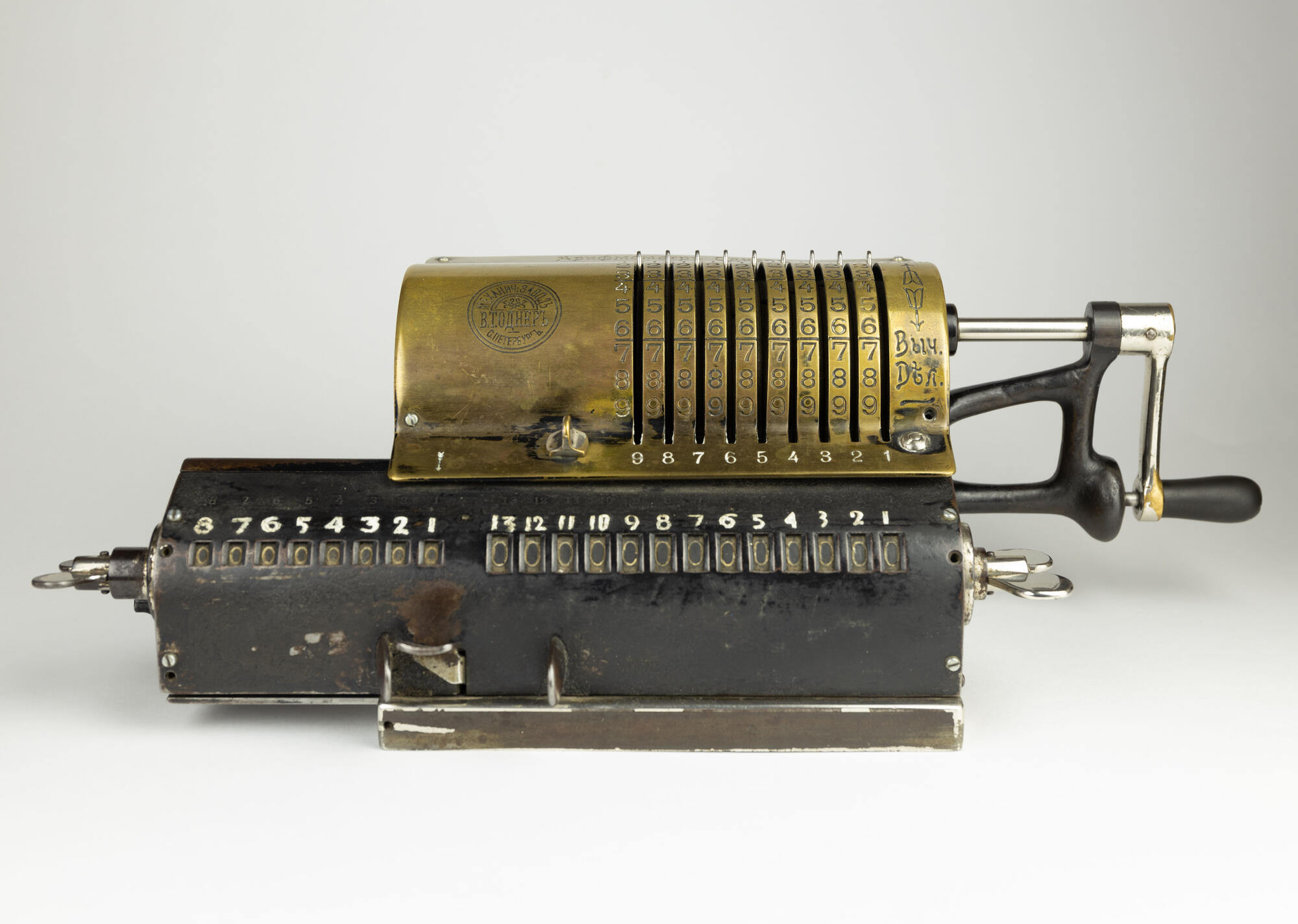


An arithmometer is a mechanical device used to perform the basic arithmetic operations: addition, subtraction, multiplication, and division. This word can be literally translated from Greek as “number meter”. The arithmometer is dubbed the grandfather of the calculator. These devices first appeared in the 17th century. The exhibition of the Glazov Museum presents one of the first Odhner arithmometers.
The main element of the arithmometer is the Odhner wheel, named after the creator. The wheel has nine teeth that drive the levers on the drum. They show the needed number, which is called an operand. To add and multiply, one needs to rotate the handle of the arithmometer clockwise, in the direction of the plus sign, whereas to subtract and divide the handle should be turned counterclockwise, in the direction of the minus sign.
The Swedish engineer Willgodt Theophil Odhner moved to Russia at the age of 23. He got a job with Ludwig Nobel, the elder brother of the Nobel Prize founder. Odhner worked as an engineer at a machine-building plant and in 1871 was asked to repair an arithmometer by Thomas de Colmar, who came up with the name of this device.
For seven years, Willgodt Odhner perfected its mechanism, and the new Odhner arithmometer was the result of this work. On the wave of success, the engineer founded his own Odhner Mechanical Plant, where 500 arithmometers were made in the first year, and six years later — more than 5,000. In 1890, the inventor published the book “The Odhner Arithmometer”, where he explained in detail the mechanism of this device and the rules for its use.
After the October Revolution of 1917, the Odhner Plant was nationalized and relocated to Moscow. It continued to produce calculators under the new name “Felix”, in honor of Felix Dzerzhinsky, until 1978. There were millions of arithmometers made with dozens of modifications. In the USSR, children were taught to use arithmometers in schools. In addition, they were used in shops, offices, institutes and factories.
The Odhner arithmometer had a simple and reliable design, as well as a convenient shape and small size. It became the first Russian export product in the field of computing equipment, was patented in many countries and won prizes at international exhibitions, in particular a gold medal at the Universal Exhibition in Paris.
The main element of the arithmometer is the Odhner wheel, named after the creator. The wheel has nine teeth that drive the levers on the drum. They show the needed number, which is called an operand. To add and multiply, one needs to rotate the handle of the arithmometer clockwise, in the direction of the plus sign, whereas to subtract and divide the handle should be turned counterclockwise, in the direction of the minus sign.
The Swedish engineer Willgodt Theophil Odhner moved to Russia at the age of 23. He got a job with Ludwig Nobel, the elder brother of the Nobel Prize founder. Odhner worked as an engineer at a machine-building plant and in 1871 was asked to repair an arithmometer by Thomas de Colmar, who came up with the name of this device.
For seven years, Willgodt Odhner perfected its mechanism, and the new Odhner arithmometer was the result of this work. On the wave of success, the engineer founded his own Odhner Mechanical Plant, where 500 arithmometers were made in the first year, and six years later — more than 5,000. In 1890, the inventor published the book “The Odhner Arithmometer”, where he explained in detail the mechanism of this device and the rules for its use.
After the October Revolution of 1917, the Odhner Plant was nationalized and relocated to Moscow. It continued to produce calculators under the new name “Felix”, in honor of Felix Dzerzhinsky, until 1978. There were millions of arithmometers made with dozens of modifications. In the USSR, children were taught to use arithmometers in schools. In addition, they were used in shops, offices, institutes and factories.
The Odhner arithmometer had a simple and reliable design, as well as a convenient shape and small size. It became the first Russian export product in the field of computing equipment, was patented in many countries and won prizes at international exhibitions, in particular a gold medal at the Universal Exhibition in Paris.