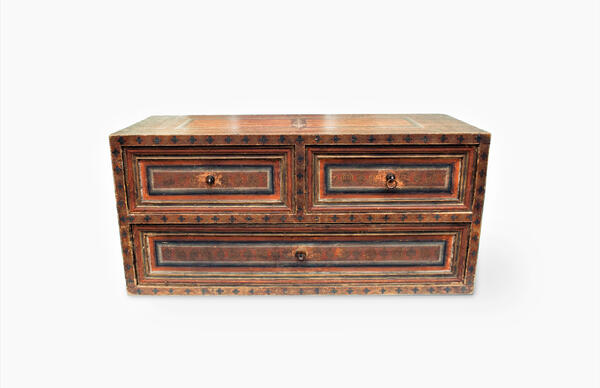
One of the basic and oldest types of furniture for nomads was aptara chests. They consisted of wooden boxes with a flat lid and varied in purpose and design.
As a rule, Tuvan carvers used larch or cedar to make furniture. Tuvans led a nomadic way of life, and all their household utensils were light and compact so that they could be easily transported. The furniture set consisted of low wooden beds and tables, a sideboard, caskets, and aptara chests, which were considered the main decorations of the interior.
In the yurt, the owners placed the aptara in the most honorable place opposite the entrance. Such a place was called ‘dor’. Aptaras were not placed on the floor, but special pedestals or separate base stands.
Masters sought to decorate richly the place of honor of the dwelling. The chests were first painted red. The pigment was made of larch bark, which was boiled for a whole day. The result was a very thick liquid. Aptaras were then painted with ornaments that symbolized wealth, fertility, prosperity, and the continuation of the family. Chests were placed so that the painted side was in full view.
Each image in Tuvan art had its meaning and mystical significance, so it was considered sacred. The spread of Buddhism had a significant influence on ornaments. On one of the chests in the collection of the Minusinsk Museum, the master depicted an elephant — a Buddhist symbol of well-being, loyalty, wisdom, and patience. Its white color signifies purity and holiness.
Chests were decorated not only with intricate designs but also with ornaments. Paintings were single and multi-colored, flat, and volumetric. The multi-colored paintings were made with oil paints, while the monochrome ones — with gold, silver, bronze, and aluminum powder. Another peculiarity of Tuvan paintings is the intertwining of decorative elements. It gave the pattern extra relief.
Tuvan ornaments were distinguished by purity and brightness. One color turned into another gradually, through shades. Combinations of pure colors were not permitted. Thanks to this colorism, the drawings had additional volume. This characteristic feature can be traced in Tuvan, Buryat, Kalmyk, and Mongolian ornamental art.
As a rule, Tuvan carvers used larch or cedar to make furniture. Tuvans led a nomadic way of life, and all their household utensils were light and compact so that they could be easily transported. The furniture set consisted of low wooden beds and tables, a sideboard, caskets, and aptara chests, which were considered the main decorations of the interior.
In the yurt, the owners placed the aptara in the most honorable place opposite the entrance. Such a place was called ‘dor’. Aptaras were not placed on the floor, but special pedestals or separate base stands.
The chests were used to store festive clothes and valuables. Usually, there were one or two aptaras with a hinged lid in the yurt for valuables and winter clothing. The chests were of different sizes. The larger aptara chests had only one-half of the lid opening.
Masters sought to decorate richly the place of honor of the dwelling. The chests were first painted red. The pigment was made of larch bark, which was boiled for a whole day. The result was a very thick liquid. Aptaras were then painted with ornaments that symbolized wealth, fertility, prosperity, and the continuation of the family. Chests were placed so that the painted side was in full view.
Each image in Tuvan art had its meaning and mystical significance, so it was considered sacred. The spread of Buddhism had a significant influence on ornaments. On one of the chests in the collection of the Minusinsk Museum, the master depicted an elephant — a Buddhist symbol of well-being, loyalty, wisdom, and patience. Its white color signifies purity and holiness.
Chests were decorated not only with intricate designs but also with ornaments. Paintings were single and multi-colored, flat, and volumetric. The multi-colored paintings were made with oil paints, while the monochrome ones — with gold, silver, bronze, and aluminum powder. Another peculiarity of Tuvan paintings is the intertwining of decorative elements. It gave the pattern extra relief.
Tuvan ornaments were distinguished by purity and brightness. One color turned into another gradually, through shades. Combinations of pure colors were not permitted. Thanks to this colorism, the drawings had additional volume. This characteristic feature can be traced in Tuvan, Buryat, Kalmyk, and Mongolian ornamental art.