

#2
#3
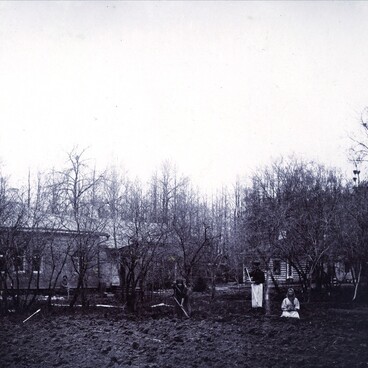
This photograph was taken after Anton Chekhov was discharged from the hospital, where he had been treated for pulmonary hemorrhage due to an attack of tuberculosis. In the winter of 1897, Chekhov was working on the story “Muzhiki” and in the spring, while in hospital, he carefully proofread and edited his text.
The story is inspired by life in Melikhovo, where the Chekhovs moved in March 1892. According to Chekhov’s brother Mikhail, the story “shows scenes and characters of Melikhovo on each page”.
Chekhov wrote to his publisher Alexei Suvorin, “I have written a story from the peasants’ life, but they say that it cannot be published and that I will have to abridge it by half.” Chekhov soon removed the chapter containing a conversation between peasants about religion and power.
The story was published in the April issue of “Russkaya Mysl”, which immediately angered the censor Sokolov. He thought that the story “describes the situation of the peasants living in the villages with excessively gloomy colors”. Chekhov wrote openly that “the peasants are rude, dishonest, dirty and drunk. Who runs a tavern and gets people drunk? The muzhik. Who squanders and drinks away community money? The muzhik.”
Sokolov’s report was sent to the Moscow Censorship Committee, and from there to Saint Petersburg, to the Main Directorate for the Press. A telegram came from Saint Petersburg, “Page 193 of Chekhov is to be removed. In case of disagreement, arrest the issue of ‘Russkaya Mysl’. This is how a fragment of text was cut out of the already printed circulation. Anton Chekhov wrote to the publicist Mikhail Menshikov, “The censors snatched a decent chunk out of “Muzhiki”. Menshikov spoke enthusiastically about the story,
“Chekhov’s new story, like his other best works, strikes by its deep knowledge of the subject. Every word, every nuance of thought shows him not as a superficial observer, but as a serious connoisseur of the subjects he portrays. Chekhov’s story is a precious contribution to the study of the people, perhaps the most important of all studies. This is the social significance of this piece of literature.”
Leo Tolstoy, however, took a completely opposite stand, “ ‘Muzhiki’ are a sin before the people. He does not know the people.”
After all the disputes, Alexey Suvorin suggested that the story “Muzhiki” be published as a separate book. Chekhov restored the text withdrawn by the censorship, and in the same year a book with two stories — “Muzhiki” and “My Life” was published. Later, Anton Pavlovich remarked, “In terms of fiction after ‘Muzhiki’ Melikhovo is already exhausted and has lost its value for me.”
The story is inspired by life in Melikhovo, where the Chekhovs moved in March 1892. According to Chekhov’s brother Mikhail, the story “shows scenes and characters of Melikhovo on each page”.
Chekhov wrote to his publisher Alexei Suvorin, “I have written a story from the peasants’ life, but they say that it cannot be published and that I will have to abridge it by half.” Chekhov soon removed the chapter containing a conversation between peasants about religion and power.
The story was published in the April issue of “Russkaya Mysl”, which immediately angered the censor Sokolov. He thought that the story “describes the situation of the peasants living in the villages with excessively gloomy colors”. Chekhov wrote openly that “the peasants are rude, dishonest, dirty and drunk. Who runs a tavern and gets people drunk? The muzhik. Who squanders and drinks away community money? The muzhik.”
Sokolov’s report was sent to the Moscow Censorship Committee, and from there to Saint Petersburg, to the Main Directorate for the Press. A telegram came from Saint Petersburg, “Page 193 of Chekhov is to be removed. In case of disagreement, arrest the issue of ‘Russkaya Mysl’. This is how a fragment of text was cut out of the already printed circulation. Anton Chekhov wrote to the publicist Mikhail Menshikov, “The censors snatched a decent chunk out of “Muzhiki”. Menshikov spoke enthusiastically about the story,
“Chekhov’s new story, like his other best works, strikes by its deep knowledge of the subject. Every word, every nuance of thought shows him not as a superficial observer, but as a serious connoisseur of the subjects he portrays. Chekhov’s story is a precious contribution to the study of the people, perhaps the most important of all studies. This is the social significance of this piece of literature.”
Leo Tolstoy, however, took a completely opposite stand, “ ‘Muzhiki’ are a sin before the people. He does not know the people.”
After all the disputes, Alexey Suvorin suggested that the story “Muzhiki” be published as a separate book. Chekhov restored the text withdrawn by the censorship, and in the same year a book with two stories — “Muzhiki” and “My Life” was published. Later, Anton Pavlovich remarked, “In terms of fiction after ‘Muzhiki’ Melikhovo is already exhausted and has lost its value for me.”
#36
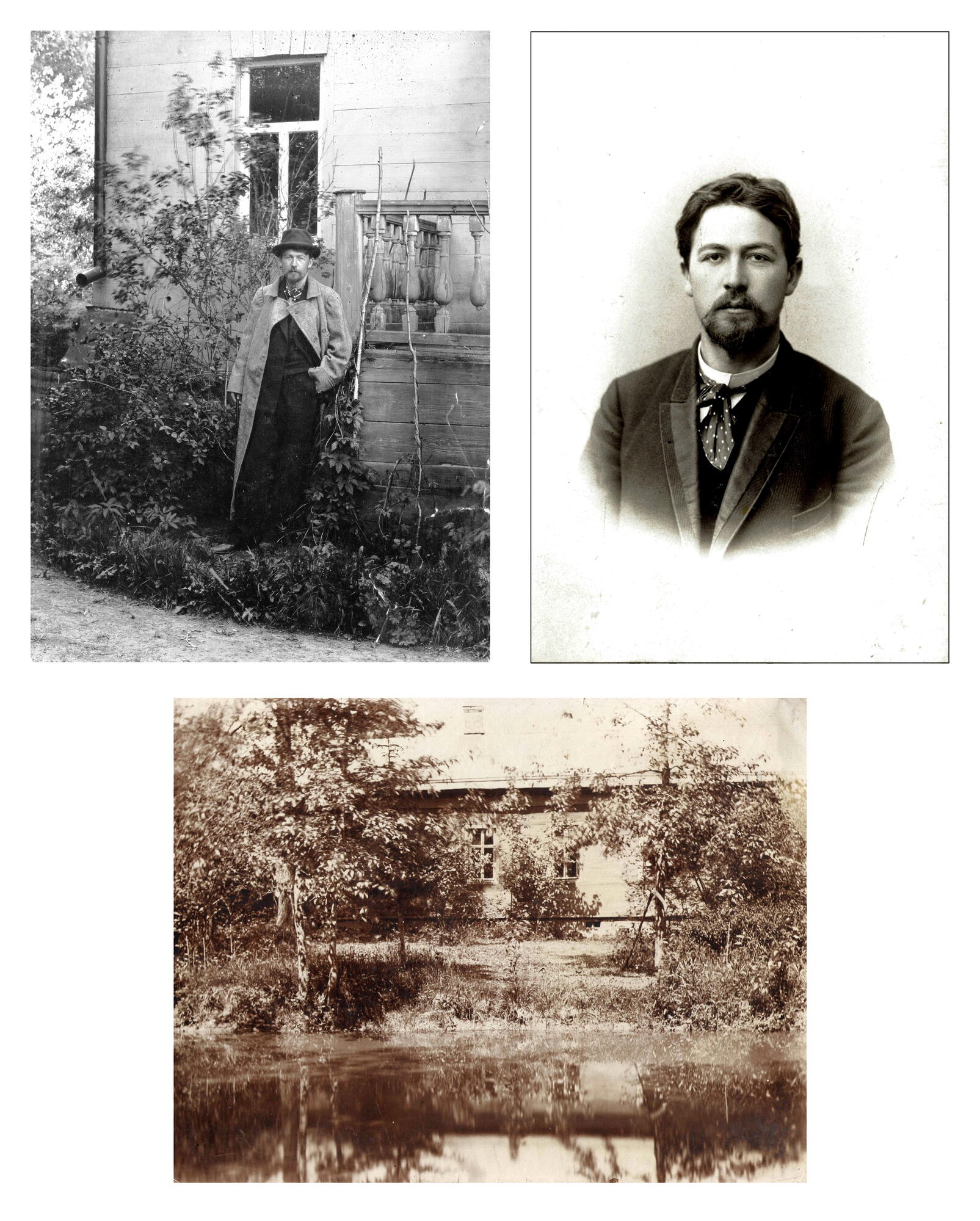
Наименование: Anton Chekhov by the terrace of the Manor house
Размеры: 14,6×10,3 см
Коллекция: The Manor House of Anton Chekhov in Melikhovo
Правообладатель изображений: The Manor House of Anton Chekhov in Melikhovo
Размеры: 14,6×10,3 см
Коллекция: The Manor House of Anton Chekhov in Melikhovo
Правообладатель изображений: The Manor House of Anton Chekhov in Melikhovo
#26
Photo portrait of Anton Chekhov
#38
Anton Chekhov considered this photograph to be his best and most accurate portrait. As a rule, Chekhov gave pictures taken in the studio to his acquaintances with a memorable or humorous caption. “In a human being everything should be beautiful: the face, the clothes, the soul, the thoughts.” These words of doctor Astrov from Chekhov’s play “Uncle Vanya” were also true of the author himself. There were many in his circle who were impressed by the taste that he always had in clothing.
Chekhov loved wearing elegant and even extravagant clothes. He knew how to find them, especially when traveling in Europe. Going to France, the capital of fashion and style, Chekhov would jokingly say, “I will come to Biarritz looking like a ragamuffin, hoping to buy myself a more Frenchy outfit; I will not buy it in Moscow.” French goods were very accessible, “cheaper than mushrooms”. It was from France that Chekhov brought his ties, shirts, coats and suits. It was also possible to buy high-quality goods in Germany, but the things Chekhov bought in Italy were a disappointment, “I bought an umbrella for Masha, but it appears to be a bad one. I also bought handkerchiefs, but they’re not good either. Rome is not Paris.” However, the writer did buy silk ties and a pin in Naples.
A Chekhov’s contemporary reminisced, “His clothes were always simple but neat; I never saw him dressed casually, without a neckband or tie, whether in the morning or late at night.” A tie, an important item of men’s clothing of the late nineteenth century, was never overlooked by the writer. In his photographs and portraits of different years he was shown wearing all sorts of ties: narrow and wide ones, those with a soft wide knot or loosely tied; he would also wear a variety of bow ties: checked, striped, colored and plain.”
Anton Chekhov appreciated perfumes and had been wearing them since a young age. Perfume was available in Moscow’s first department store, “Mur & Merilize”, or in Popov’s Passage, where Chekhov often asked his sister to stop by for perfume. In one of his letters to a female friend of his, recovering from a pulmonary hemorrhage, found the strength to joke, “See, what a cripple I am. But I carefully hide it and try to look like a cheerful young man of 28, and I succeed very often, as I buy expensive ties and perfume Vera-Violetta.” Chekhov wrote this letter at the age of 37.
Chekhov loved wearing elegant and even extravagant clothes. He knew how to find them, especially when traveling in Europe. Going to France, the capital of fashion and style, Chekhov would jokingly say, “I will come to Biarritz looking like a ragamuffin, hoping to buy myself a more Frenchy outfit; I will not buy it in Moscow.” French goods were very accessible, “cheaper than mushrooms”. It was from France that Chekhov brought his ties, shirts, coats and suits. It was also possible to buy high-quality goods in Germany, but the things Chekhov bought in Italy were a disappointment, “I bought an umbrella for Masha, but it appears to be a bad one. I also bought handkerchiefs, but they’re not good either. Rome is not Paris.” However, the writer did buy silk ties and a pin in Naples.
A Chekhov’s contemporary reminisced, “His clothes were always simple but neat; I never saw him dressed casually, without a neckband or tie, whether in the morning or late at night.” A tie, an important item of men’s clothing of the late nineteenth century, was never overlooked by the writer. In his photographs and portraits of different years he was shown wearing all sorts of ties: narrow and wide ones, those with a soft wide knot or loosely tied; he would also wear a variety of bow ties: checked, striped, colored and plain.”
Anton Chekhov appreciated perfumes and had been wearing them since a young age. Perfume was available in Moscow’s first department store, “Mur & Merilize”, or in Popov’s Passage, where Chekhov often asked his sister to stop by for perfume. In one of his letters to a female friend of his, recovering from a pulmonary hemorrhage, found the strength to joke, “See, what a cripple I am. But I carefully hide it and try to look like a cheerful young man of 28, and I succeed very often, as I buy expensive ties and perfume Vera-Violetta.” Chekhov wrote this letter at the age of 37.
#37
Наименование: Photo portrait of Anton Chekhov
Размеры: 16,8×10,8 см
Коллекция: The Manor House of Anton Chekhov in Melikhovo
Правообладатель изображений: The Manor House of Anton Chekhov in Melikhovo
Размеры: 16,8×10,8 см
Коллекция: The Manor House of Anton Chekhov in Melikhovo
Правообладатель изображений: The Manor House of Anton Chekhov in Melikhovo
#18
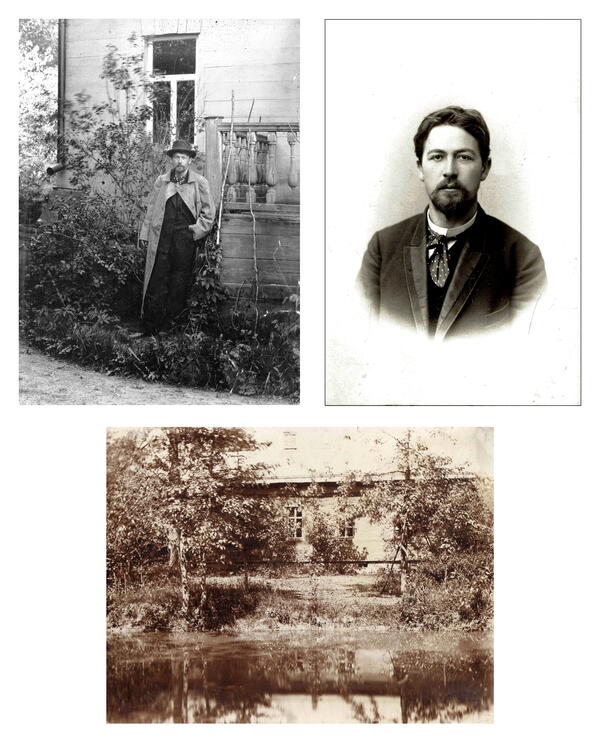
View of the house, “Aquarium” pond
#39
Shortly after buying the estate in Melikhovo, Anton Pavlovich Chekhov began to take care of a small pond. He wrote to his brother Alexander on March 21, 1892, “The pond is in the garden, 20 paces from the house. It is deep, 6 arshins. What a pleasure to fill it with snow and anticipate the time when the fish will splash out of its depths!” Chekhov was worried that water would be scarce in the spring, and several times a day he threw snow into the pond.
Apart from tench, carp inhabited the pond in the spring, and Anton Pavlovich was going to make it a flow-through pond and breed sterlet in the future. In fact, he dug a large pond behind the manor house, which became similar to an ichthyological station. “The home pond” was also greatly enlarged and deepened, and the soil was deposited at the fence. A nice hill was formed in this place, where the painter Levitan liked to work.
Anton Chekhov loved the very process of fishing, so he always “gave the constitution” to the fish he caught, by immediately releasing it back into the pond. He knew the intricacies of fishing, using various tackle: rods, seine, creel — a fishing tackle made of rods in the form of a funnel, and zherlitsa — a pike tackle.
In the first spring in Melikhovo, much had to be done anew, as the household was in disrepair. The Chekhovs worked together, improving both the house and the plot. Despite hardships, Anton Pavlovich loved country life and repeatedly admitted, “My thoughts are about oats and clover, but my soul is in a pond with crucians.”
In his letters to almost all his acquaintances Chekhov mentioned the pond in which it was possible to fish from the window of the house. Some of his guests were brave enough to swim in the “aquarium”. The writer’s brother Mikhail Pavlovich recalled how the writers Pyotr Sergeyenko and Ignaty Potapenko came to Melikhovo during the first summer. Seeing the pond, which was not clean and had already begun to turn green, Sergeyenko climbed into it and started to swim.
“Potapenko! — he shouted from the water. — Why aren’t you swimming? Get undressed quickly!”
” Why would I bathe in this filthy puddle?”, Potapenko answered.
” Try it!”
” I don’t even want to try it. It’s all mud!”
“But there is no such thing as mud in chemistry. Look at it with your professor’s eye!”
” I won’t even look at it.”
“Well, do Anton a favor, take a swim in that puddle of his! Do him a favor. It’s rude of you. To come to a new landowner and not bathe in his cesspool.”
Apart from tench, carp inhabited the pond in the spring, and Anton Pavlovich was going to make it a flow-through pond and breed sterlet in the future. In fact, he dug a large pond behind the manor house, which became similar to an ichthyological station. “The home pond” was also greatly enlarged and deepened, and the soil was deposited at the fence. A nice hill was formed in this place, where the painter Levitan liked to work.
Anton Chekhov loved the very process of fishing, so he always “gave the constitution” to the fish he caught, by immediately releasing it back into the pond. He knew the intricacies of fishing, using various tackle: rods, seine, creel — a fishing tackle made of rods in the form of a funnel, and zherlitsa — a pike tackle.
In the first spring in Melikhovo, much had to be done anew, as the household was in disrepair. The Chekhovs worked together, improving both the house and the plot. Despite hardships, Anton Pavlovich loved country life and repeatedly admitted, “My thoughts are about oats and clover, but my soul is in a pond with crucians.”
In his letters to almost all his acquaintances Chekhov mentioned the pond in which it was possible to fish from the window of the house. Some of his guests were brave enough to swim in the “aquarium”. The writer’s brother Mikhail Pavlovich recalled how the writers Pyotr Sergeyenko and Ignaty Potapenko came to Melikhovo during the first summer. Seeing the pond, which was not clean and had already begun to turn green, Sergeyenko climbed into it and started to swim.
“Potapenko! — he shouted from the water. — Why aren’t you swimming? Get undressed quickly!”
” Why would I bathe in this filthy puddle?”, Potapenko answered.
” Try it!”
” I don’t even want to try it. It’s all mud!”
“But there is no such thing as mud in chemistry. Look at it with your professor’s eye!”
” I won’t even look at it.”
“Well, do Anton a favor, take a swim in that puddle of his! Do him a favor. It’s rude of you. To come to a new landowner and not bathe in his cesspool.”
#40
Наименование: View of the house, “Aquarium” pond
Размеры: 13×18 см
Коллекция: The Manor House of Anton Chekhov in Melikhovo
Правообладатель изображений: The Manor House of Anton Chekhov in Melikhovo
Размеры: 13×18 см
Коллекция: The Manor House of Anton Chekhov in Melikhovo
Правообладатель изображений: The Manor House of Anton Chekhov in Melikhovo
#35
Ministry of Culture of the Russian Federation
read morehide
Chekhov, Photo of Chekhov, “Aquarium” pond
Collection
0
 Point your smartphone camera to open in the app
Open in app
Share