#3
#25
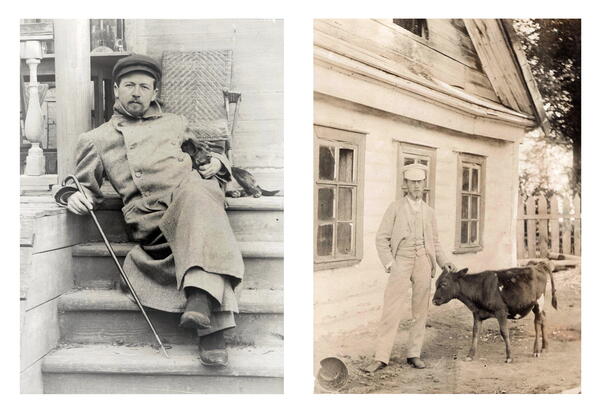
The photograph was taken while Anton Chekhov was recovering from a severe pulmonary hemorrhage. He spent the end of March and the beginning of April 1897 in the Ostroumov Clinic in Moscow, where the writer was diagnosed with an apical process and given a final diagnosis of pulmonary tuberculosis. This was concealed from his father and mother, at Chekhov’s request.
Anton Chekhov wrote in May 1897, “The doctors have forbidden me to work, and I now play something akin to a theater official: doing nothing, being useless to others, but trying to keep a business-like appearance.”
With his left hand the writer is hugging his pet, a dachshund named Bromine. Anton Pavlovich loved all animals, but it was dogs that enjoyed his special favor. Together with the Melikhovo estate Chekhov received from the former owner watch dogs, including Sharik, Arapka, as well as mongrel puppies Muir and Meriliz.
Two “dachshunds” were given to Chekhov by the publisher Nikolay Leikin, who may have suggested to the writer the plot of “Kashtanka” several years before. At night in Melikhovo the dachshunds raked the soil with the seeds sown out of the flower boxes and scattered overshoes all over the place, and in the morning, they stirred up a commotion in the yard with the local dogs. They were given “medical” names Quinine and Bromine. Quinine was brown and Bromine was black.
Anton Chekhov wrote, “I have news: two dachshunds Bromine and Quinine, ugly-looking dogs. Their paws are crooked, their bodies are long, but their minds are extraordinary.”
Chekhov informed his many friends about events in the life of the dachshunds, but he gave the most detailed reports on developments in the life of Bromine and Quinine, to the publisher Nikolay Leikin, the master of Bromine and Quinine’s parents:
“Dachshunds Bromine and Quinine are in good health. The former is agile and flexible, polite and sensitive, the latter is clumsy, fat, lazy and sly. The former loves birds, the latter pokes his nose in the ground. Both are full love. They understand why they are punished. They like to walk in the field and in the woods, but only with us. I have to nag them almost every day, they grab the patients by their pants, quarrel when they eat, etc. They sleep in my room.”
The writer’s brother Mikhail Chekhov reminisced, “Every evening Quinine would come up to Anton Pavlovich, lay her front paws on his lap and look pitifully and devotedly into his eyes. He would change his expression and with a broken, senile voice would say, ‘Quinine Markovna! You poor thing! You should go to the hospital! You’d feel better there! ’ He spent half an hour talking to the dog, which would make the whole household die laughing. Then it was Bromine’s turn…”
Anton Chekhov wrote in May 1897, “The doctors have forbidden me to work, and I now play something akin to a theater official: doing nothing, being useless to others, but trying to keep a business-like appearance.”
With his left hand the writer is hugging his pet, a dachshund named Bromine. Anton Pavlovich loved all animals, but it was dogs that enjoyed his special favor. Together with the Melikhovo estate Chekhov received from the former owner watch dogs, including Sharik, Arapka, as well as mongrel puppies Muir and Meriliz.
Two “dachshunds” were given to Chekhov by the publisher Nikolay Leikin, who may have suggested to the writer the plot of “Kashtanka” several years before. At night in Melikhovo the dachshunds raked the soil with the seeds sown out of the flower boxes and scattered overshoes all over the place, and in the morning, they stirred up a commotion in the yard with the local dogs. They were given “medical” names Quinine and Bromine. Quinine was brown and Bromine was black.
Anton Chekhov wrote, “I have news: two dachshunds Bromine and Quinine, ugly-looking dogs. Their paws are crooked, their bodies are long, but their minds are extraordinary.”
Chekhov informed his many friends about events in the life of the dachshunds, but he gave the most detailed reports on developments in the life of Bromine and Quinine, to the publisher Nikolay Leikin, the master of Bromine and Quinine’s parents:
“Dachshunds Bromine and Quinine are in good health. The former is agile and flexible, polite and sensitive, the latter is clumsy, fat, lazy and sly. The former loves birds, the latter pokes his nose in the ground. Both are full love. They understand why they are punished. They like to walk in the field and in the woods, but only with us. I have to nag them almost every day, they grab the patients by their pants, quarrel when they eat, etc. They sleep in my room.”
The writer’s brother Mikhail Chekhov reminisced, “Every evening Quinine would come up to Anton Pavlovich, lay her front paws on his lap and look pitifully and devotedly into his eyes. He would change his expression and with a broken, senile voice would say, ‘Quinine Markovna! You poor thing! You should go to the hospital! You’d feel better there! ’ He spent half an hour talking to the dog, which would make the whole household die laughing. Then it was Bromine’s turn…”
#26
Наименование: Anton Chekhov on the veranda with a dachshund
Размеры: 16,2×10,3 см
Коллекция: The Manor House of Anton Chekhov in Melikhovo
Правообладатель изображений: The Manor House of Anton Chekhov in Melikhovo
Размеры: 16,2×10,3 см
Коллекция: The Manor House of Anton Chekhov in Melikhovo
Правообладатель изображений: The Manor House of Anton Chekhov in Melikhovo
#27
Mikhail Pavlovich Chekhov with a calf
#28
Mikhail Pavlovich Chekhov was the youngest son in the Chekhov family; he was born in Taganrog when Anton was five years old. Mikhail was interested in literature since childhood, and as a third-grade student he published poetry in the magazine “Light and Shadows”. After his father’s bankruptcy the family came to Moscow, and the 11-year-old boy “assigned himself” to a gymnasium when he risked having to work in a merchant’s barn.
Like his elder brothers, Mikhail Pavlovich entered Moscow University. He chose the faculty of law, was a keen student, and especially loved the historical lectures of Vasily Klyuchevsky. An artist by nature, Mikhail Chekhov had to earn a living after graduation by working as a tax inspector. When the Chekhovs moved to Melikhovo, Mikhail came there every summer. He grew very close to his brother Anton, helped him with everything and got interested in literature again.
Mikhail Chekhov started by publishing his translations, and his first book was a dictionary for farmers, “Zakrom”. Mikhail Pavlovich tried his hand at writing scripts and acting for an amateur troupe, was interested in theater, and published his reviews in the Moscow magazine Theater and Art. He wrote a lot for children, his stories were published under pseudonyms in the magazines “Children’s Leisure”, “Children’s Friend” and “Rodnik”.
Anton Pavlovich remarked on his brother’s success, “Misha is capable of writing a historical novel for children”. But he never saw the heyday of Mikhail’s career as a publicist. Thanks to his brother’s advice, Mikhail left the civil service, moved to Saint Petersburg, and took up literary work. After Anton Chekhov’s death, Mikhail wrote a few books, hundreds of essays and stories, won the Pushkin Prize of the Academy of Sciences, and published the children’s magazine “Golden Childhood” for 10 years.
Mikhail Chekhov was married to Olga Germanovna Vladykina, who shared his theater interests. They had two children: their daughter Evgeniya became a singer, and their son Sergey was a graphic artist. Mikhail Pavlovich also drew a lot, there are illustrations to his letters and his watercolors with views of the Caucasus and Crimea.
Mikhail Chekhov’s main work was memoirs about his brother. He was Anton Chekhov’s first biographer. Together with his sister Maria he published several books of memoirs about him, six volumes of his letters, worked at the Chekhov Museum in Moscow and was a research associate of the Chekhov House-Museum in Yalta till the end of his life. His book “Around Chekhov” published in 1933 was called “the Chekhov encyclopedia”.
Like his elder brothers, Mikhail Pavlovich entered Moscow University. He chose the faculty of law, was a keen student, and especially loved the historical lectures of Vasily Klyuchevsky. An artist by nature, Mikhail Chekhov had to earn a living after graduation by working as a tax inspector. When the Chekhovs moved to Melikhovo, Mikhail came there every summer. He grew very close to his brother Anton, helped him with everything and got interested in literature again.
Mikhail Chekhov started by publishing his translations, and his first book was a dictionary for farmers, “Zakrom”. Mikhail Pavlovich tried his hand at writing scripts and acting for an amateur troupe, was interested in theater, and published his reviews in the Moscow magazine Theater and Art. He wrote a lot for children, his stories were published under pseudonyms in the magazines “Children’s Leisure”, “Children’s Friend” and “Rodnik”.
Anton Pavlovich remarked on his brother’s success, “Misha is capable of writing a historical novel for children”. But he never saw the heyday of Mikhail’s career as a publicist. Thanks to his brother’s advice, Mikhail left the civil service, moved to Saint Petersburg, and took up literary work. After Anton Chekhov’s death, Mikhail wrote a few books, hundreds of essays and stories, won the Pushkin Prize of the Academy of Sciences, and published the children’s magazine “Golden Childhood” for 10 years.
Mikhail Chekhov was married to Olga Germanovna Vladykina, who shared his theater interests. They had two children: their daughter Evgeniya became a singer, and their son Sergey was a graphic artist. Mikhail Pavlovich also drew a lot, there are illustrations to his letters and his watercolors with views of the Caucasus and Crimea.
Mikhail Chekhov’s main work was memoirs about his brother. He was Anton Chekhov’s first biographer. Together with his sister Maria he published several books of memoirs about him, six volumes of his letters, worked at the Chekhov Museum in Moscow and was a research associate of the Chekhov House-Museum in Yalta till the end of his life. His book “Around Chekhov” published in 1933 was called “the Chekhov encyclopedia”.
#29
Наименование: Mikhail Pavlovich Chekhov with a calf
Размеры: 13,7×10 см
Коллекция: The Manor House of Anton Chekhov in Melikhovo
Правообладатель изображений: The Manor House of Anton Chekhov in Melikhovo
Размеры: 13,7×10 см
Коллекция: The Manor House of Anton Chekhov in Melikhovo
Правообладатель изображений: The Manor House of Anton Chekhov in Melikhovo
#30
Ministry of Culture of the Russian Federation
read morehide
A.P. Chekhov with a dachshund, Mikhail Chekhov
Collection
0
 Point your smartphone camera to open in the app
Open in app
Share