The first photograph that has survived to this day is a heliographic engraving by Joseph Nicéphore Niépce. He took it in France in 1826. It is called “View from the Window at Le Gras.” The photographer captured a view from the window of his workshop in Saint-Loup-de-Varenne. However, the process of taking the photograph and printing it was still very laborious.
In 1888, Kodak released the first camera that used a film roll. This event can be considered the beginning of amateur photography. Gradually, photo studios began opening in countries around the world. In the second half of the 19th century, Europe saw the rise of the “carte de visite”. It was a small photographic image that could be sent by mail as a keepsake with wishes written on it. Photo studios offered carte de visites featuring portraits of famous people, such as members of royal families, politicians, actresses, and athletes.
One of the artists creating such photos was André Adolphe-Eugène Disdéri. His photo studio in Paris had around 80 employees. Between 1861 and 1867, more than 800,000 cards were sold. The photographer also took a picture of the French Emperor Napoleon III and his wife, as well as the Italian composer Giuseppe Verdi. His most famous work was the “Imperial Court of Napoleon III” card, also known as “Mosaic”. It measured 10.5 by 6.1 centimeters and depicted dozens of people, with their faces seen clearly in the picture.
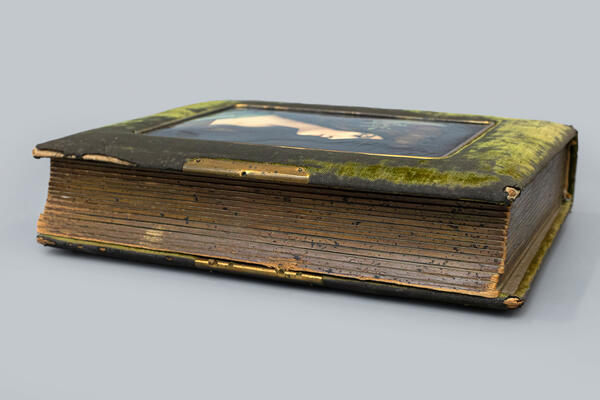
There were also specialized albums for carte de visite photographs. These were bound books, often designed in the Art Nouveau style. The thick pages had slots for inserting the photos. However, they were not suitable for collecting other types of photographs, postcards, clippings, letters, or prints.
A photo album in leather, velvet, or silk binding became a decorative item. It was adorned with gilding, bas-reliefs, mother-of-pearl inlays, and even gemstones. The design of the photo album evolved alongside technology, and manufacturers took into account popular image formats. In the 20th century, photography became more accessible, and the design of photo albums simplified. The album from the museum collection dates back to the early 20th century. It is covered in green velvet.