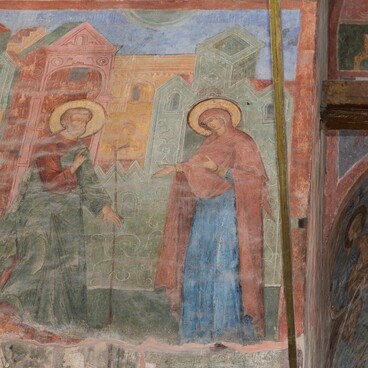
The composition ‘Annunciation’ of the Akathist to the Blessed Virgin Mary (Kontakion 3) is presented on the fresco: ‘The power of the Most High then overshadowed the Virgin for conception, and showed Her fruitful womb as a sweet meadow to all who wish to reap salvation, as they sing: Alleluia! ’
Archangel Gabriel on a cloud is in the upper room to the Virgin Mary, who meets the messenger while reading. This is a characteristic motif of the Western European iconography ‘Annunciation’, based on the apocryphal Gospel of Pseudo-Matthew (the end of the 6th -–the mid-7th centuries). This iconography is widely used in Russian art of the 17th century under the influence of Western European engravings. The book contains lines of the ikos 2 of the Akathist, missing in the mural paintings: ‘Seeking to know knowledge that cannot be known, the Virgin cried to the ministering one: Tell me, how can a son be born from a chaste womb? Then he spake to Her in fear, only crying aloud thus’.
General information:
The Akathist Hymn is one of the most well-loved services of devotion in the Orthodox Church. The Akathist to the Holy Virgin is a praise hymn in Her honor, composed in Byzantium between the 5th and 7th centuries. In the Russian tradition of authorship is attributed to Venerable Roman the Melodist (6th century). The cycle of illustrations of Akathist is traditionally included in the decoration system of the Virgin temples and temples dedicated to other people and events. In ancient Russian monumental painting of the 16th–17th centuries, it is often adjacent to the cycle of the Protoevangelium of James.
Full title: Akathist to the Blessed Virgin Mary. Kontakion 3
Time of creation: 1641
Technique: Fresco, tempera
Location: East arch cheek between the south-west pillar and the south wall