#1

Banknote, Insurance Plaque
#2
#4

#3
The history of the cooperative movement in Russia is over a century-long. Mytishchi was one of the first cities where consumer cooperation became popular. A consumers' cooperative is a voluntary union. The initial property of a consumers' cooperative is composed of contributions of its members.
The cooperative movement grew rapidly in Russia in the late 19th century. The goals of the Cooperative are defined in the first paragraph of their 1898 Charter: ‘The Mytishchi Consumer’s Cooperative of Workers is established in Mytishchi with the goal of providing its members with consumer and household goods at the lowest price possible or at a moderate price and give its members an opportunity to make savings with the profit from this business activity’.
By 1917, the Mytishchi Consumers' Cooperative was one of the largest in Russia. Its assets tallied 577,000 rubles with an annual turnover of 2,994,000 rubles. By the 1930s, the Consumers' Cooperative covered 18.2% of all population of the Mytishchi District, mostly villagers. The number of members reached 3,031. During the Great Patriotic War, the Consumers' Cooperative of Mytishchi maintained their potential and did a lot to provide the locals with food.
The front of the banknote features text and the phrase “The Mytishchi Consumers' Cooperative of Workers. MCC. Seven rubles. Freeing workers is the workers' own job. Chairman of the Board. Secretary of the Board. Member of the Board. Established in 1899. Seven rubles.” The back of the note reads: “This banknote is in circulation only in the stores of the Mytishchi Consumers' Cooperative of Workers. The Mytishchi Consumers' Cooperative shall not be held liable to compensation in case of loss of this banknote.” The banknote features a popular type of graphic abbreviation: the letters МПО (MCC) stand for the MYTISHCHI Consumers' Cooperative in Russian. Chafing marks and tears on the banknote are indicative of its heavy use.
#5
Author: unknown
Date: early 20th century
Technique: сolored print, paper
Place: Russia
Dimensions: 8×12 cm
Collection: Numismatics
Copyright: Municipal Budget Cultural Institution “Mytishchi History and Art Museum”
Date: early 20th century
Technique: сolored print, paper
Place: Russia
Dimensions: 8×12 cm
Collection: Numismatics
Copyright: Municipal Budget Cultural Institution “Mytishchi History and Art Museum”
#6
Insurance Plaque of the Second Russian Society
#7

#8
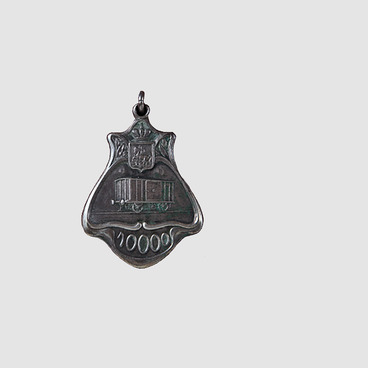
In the 19th — early 20th century, most buildings in Russia were wooden, so they were often destroyed in fire which resulted in losses. Naturally, people did their best to prevent fires and insured their houses. As a result, the first insurance agencies appeared. Fire insurance was the leading type of insurance in terms of demand.
Starting from 1820s, new types of insurances companies were created in Russia, for example, state-funded, joint-stock, zemstvo-based (administrative unit), and mutual. Since fires were frequent in Russian provinces, the insurance sector grew quickly. The overwhelming commercial success of the first insurance agency inspired a few government officials to present a new initiative. In 1834, the Head of His Imperial Majesty’s Office count Alexander von Benckendorf suggested to start a new fire insurance company that would provides services in the 40 governorates not covered by the first agency. In 1835, the Emperor signed the decree to create the Second Russian Fire Insurance Society. By the late 19th century, insurance companies became an indispensable part of the Russian economy, and several types of insurance companies already existed.
Zemstvo insurance was divided into three groups: fixed-rate, supplementary, and voluntary. After signing a contract, the insurance society gave the insured party a plaque they could hang on their house. One of such plaques is presented at the exhibition. Plaques were divided into medium and large, depending on the size of insured property. They were almost the same shape, colors, and text, and only slightly differed in size and purpose. Paragraph 35 of the Charter of the Second Russian Fire Insurance Society stated that both real estate and personal property was subject to insurance, for example: houses, factories and plants of all kinds, furniture, household appliances, fancy articles, clothing, all kinds of machinery, goods in houses, shops, barns, on ships, and stored separately. However, they did not insure contracts, liabilities, documents, promissory notes and all kinds of loans, gold and silver in bars and coins, paper money and other public bonds, precious stones, medals, antiques, paintings, gunpowder, and flammable materials. Each insured party received an insurance policy that contained liabilities of both parties. One of the directors signed it and a manager of the Society put a stamp on it. It was not allowed to give the policy to third parties without prior agreement of the Society.
Large plaques were about 25 centimeters high and were hanged in clearly visible but hard-to-reach spots on facades. plaques were up to 12 centimeters high and were placed near or on the door of the insured apartment.
For small personal property tiny plaques about 6 to 7 cm long were used. However, they did not become popular. In some cases, one insurance company could produce plaques of different shapes, design, and color scheme. Most of them were oval or rectangular but there were also round, square, diamond-shaped, hexagonal, and octagonal ones.
#9
Author: unknown
Date: late 19th — early 20th century
Technique: stamping
Place: Russia
Dimensions: 34×34 cm
Collection: Metal
Copyright: Municipal Budget Cultural Institution “Mytishchi History and Art Museum”
Date: late 19th — early 20th century
Technique: stamping
Place: Russia
Dimensions: 34×34 cm
Collection: Metal
Copyright: Municipal Budget Cultural Institution “Mytishchi History and Art Museum”
#10
Municipal Budget Cultural Institution “Mytishchi History and Art Museum”
read morehide
00:00
00:00
1x
2
 Point your smartphone camera to open in the app
Open in app
Share