#1
5 bricks
#2
#3
#4
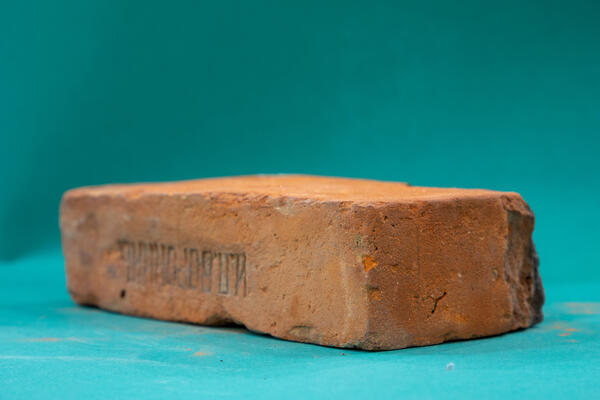
Ivan Voronin, who came from a merchant family in Sergiyev Posad, was a major brick factory owner in the Mytishchi Volost (rural district). Voronin’s business in Mytishchi was established in 1897. The Main Land Office issued the permission in 1897 that allowed Voronin to rent a land lot “for clay and sand extraction and construction of a factory” for 36 years, with a total area of 0.468 sq. m.
According the the documents, the land that Voronin rented was a part of the Rupasovo village. It bordered on the Moscow-Yaroslavl-Arkhangelsk railway and the state-owned land, on the land of the Perlovo dachas (summer house community), on the Tarasovskaya village, and on the Cherkizovo village.
By 1900, they built a baking kiln with a fire tube, drying barns for mudbricks, tents for bricks, and a stone forge. At the same time, an office, a kitchen, a two-story barrack, eight one-story residential houses for the workers, and a sauna were added to the factory. All building were made of logs and had an iron roof. In summer 620 people worked at the factory, and 200 people worked there in winter.
The factory was profitable immediately. The owners spent quite a lot on money on technological upgrades. In 1912–1914, he reconstructed brick kilns and replaced manual molding with machine molding on new belt presses. In the extension of the engine room he installed a compression plant and bought the first available excavator to extract clay. He laid extra narrow-gauge railways and bought carts to transport clay and sand. They used a portable engine to mold and dry peat bricks.
The old processing line left after the upgrade was re-purposed for production of high-quality manually molded bricks by seasonal workers. In every workplace they installed manual presses for a tighter molding. Such bricks were top-quality and very expensive so the factory produced them in small batches and only on prepay basis.
During World War One, the factory paid considerable sums of money to the Military Department that was used for urgent construction of artillery ammunition factories. They also paid allowance to the families of employees drafted to the army. The factory also sent money to the hospitals and infirmaries of the Mytishchi Volost to buy medical supplies, paid the food expenses for the sick and the wounded who returned from the frontline and paid allowance to their families.
The factory shared their stock of fuel to heat up hospitals and paid extra to doctors, paramedics, and employees. Until June 1918, they owner of the factory regularly paid a 5% tax on his total income to the State Treasury.
According the the documents, the land that Voronin rented was a part of the Rupasovo village. It bordered on the Moscow-Yaroslavl-Arkhangelsk railway and the state-owned land, on the land of the Perlovo dachas (summer house community), on the Tarasovskaya village, and on the Cherkizovo village.
By 1900, they built a baking kiln with a fire tube, drying barns for mudbricks, tents for bricks, and a stone forge. At the same time, an office, a kitchen, a two-story barrack, eight one-story residential houses for the workers, and a sauna were added to the factory. All building were made of logs and had an iron roof. In summer 620 people worked at the factory, and 200 people worked there in winter.
The factory was profitable immediately. The owners spent quite a lot on money on technological upgrades. In 1912–1914, he reconstructed brick kilns and replaced manual molding with machine molding on new belt presses. In the extension of the engine room he installed a compression plant and bought the first available excavator to extract clay. He laid extra narrow-gauge railways and bought carts to transport clay and sand. They used a portable engine to mold and dry peat bricks.
The old processing line left after the upgrade was re-purposed for production of high-quality manually molded bricks by seasonal workers. In every workplace they installed manual presses for a tighter molding. Such bricks were top-quality and very expensive so the factory produced them in small batches and only on prepay basis.
During World War One, the factory paid considerable sums of money to the Military Department that was used for urgent construction of artillery ammunition factories. They also paid allowance to the families of employees drafted to the army. The factory also sent money to the hospitals and infirmaries of the Mytishchi Volost to buy medical supplies, paid the food expenses for the sick and the wounded who returned from the frontline and paid allowance to their families.
The factory shared their stock of fuel to heat up hospitals and paid extra to doctors, paramedics, and employees. Until June 1918, they owner of the factory regularly paid a 5% tax on his total income to the State Treasury.
#5
Date: early 20th century
Technique: clay, baking, molding
Dimensions: 27×12,5×7 cm
Copyright: Municipal Budget Cultural Institution “Mytishchi History and Art Museum”
Collection: Glass, Ceramics, Porcelain
Goskatalog Number: 21825807
Technique: clay, baking, molding
Dimensions: 27×12,5×7 cm
Copyright: Municipal Budget Cultural Institution “Mytishchi History and Art Museum”
Collection: Glass, Ceramics, Porcelain
Goskatalog Number: 21825807
#6
Brick with the Brand ‘A. Gusarev’
#7
#8
The Mytishchi brick manufacturers made an enormous contribution to the construction of Moscow and the Moscow Region and the history of their land. The nature blessed them with large reserves of clay dated the Jurassic period. They allowed brick manufacturers of Mytishchi to constantly expand their capacity. Manufacturers rented land long-term only if its clay reserves were enough to last at least ten years at minimum production output of one million bricks a year.
The establish a factory with a capacity of one million bricks a year, one needed the startup capital of 10,000 rubles. The expenses paid off in three to four years. Often, manufacturers had to establish several factories or join capitals and create a joint-stock company. For example, this is how the brick factory of the merchant Alexei Gusarev and Vasily Chelnokov was established in 1871 on the land rented from peasants of the Sharapovo village.
Apart from the factory in Mytishchi, the honorary citizen Alexei Gusarev also owned a brick factory in the Lefortovo District of Moscow, near the Cherkizovo village. At the best of times, Gusarev’s Moscow factory produced up to 9 million bricks a year. In 1872, the succeeding manufacturer sold his factory in Moscow to the merchant Chelnokov.
Since the 1870s, Russia began to import brick production machinery from England, France, and Germany. However, not every manufacturer could afford a technical upgrade. Besides, maintenance was costly, too, and as a result, the cost of hand-molded and machine-molded bricks was almost the same. On top of it all, customers were suspicious about machine-made bricks because the quality of handmade bricks was generally better and manual production of bricks was polished to perfection.
On the cusp of 19th–20th century, Russia experienced an explosive growth of industry: more factories and plants were established, the railway network expanded quickly. However, Russia was still behind Europe and America in terms of brick production. The USA produced 150 bricks per person, England produced 90, Germany — 60, and Russia produced only 9.
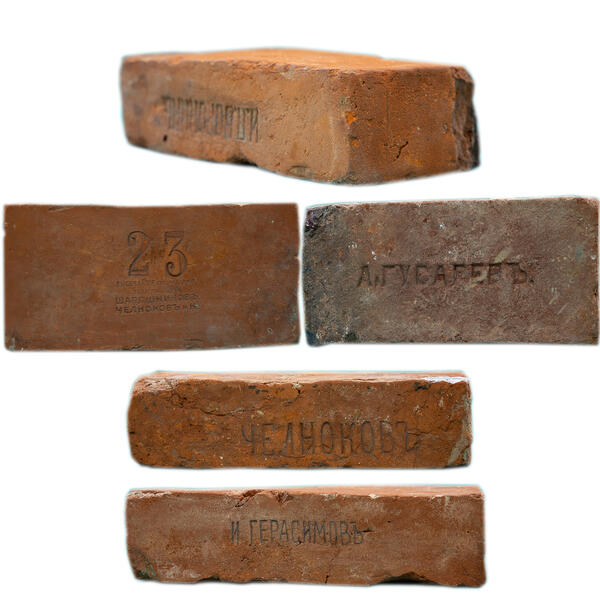
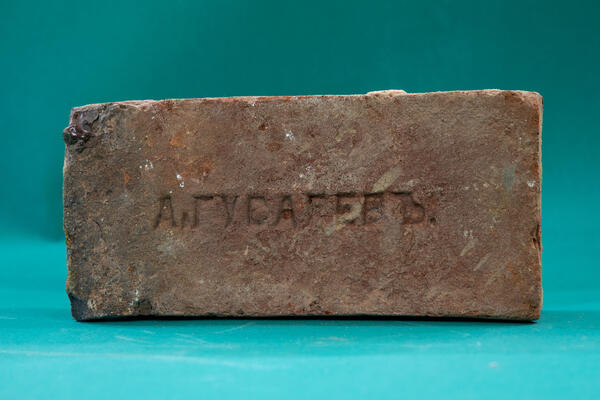
The Moscow Governorate was the largest manufacturer of bricks in Russia. It produced about 140 million bricks a year, and the factories in Mytishchi alone supplied over 45 million bricks–almost 30% of the total amount manufactured in the Governorate. So it is no surprise that every third or fourth house and industrial facility in Moscow and the Moscow Region is made from the bricks produced by the factories of Mytishchi. We can see the proof of it in the brand marks on the bricks. The brand mark “A. Gusarev” can be seen in foundations of old houses in Sharapovka, the State Historical Museum of Moscow, the Moscow Polytechnic Museum, and the Tretyakov Drive.
The establish a factory with a capacity of one million bricks a year, one needed the startup capital of 10,000 rubles. The expenses paid off in three to four years. Often, manufacturers had to establish several factories or join capitals and create a joint-stock company. For example, this is how the brick factory of the merchant Alexei Gusarev and Vasily Chelnokov was established in 1871 on the land rented from peasants of the Sharapovo village.
Apart from the factory in Mytishchi, the honorary citizen Alexei Gusarev also owned a brick factory in the Lefortovo District of Moscow, near the Cherkizovo village. At the best of times, Gusarev’s Moscow factory produced up to 9 million bricks a year. In 1872, the succeeding manufacturer sold his factory in Moscow to the merchant Chelnokov.
Since the 1870s, Russia began to import brick production machinery from England, France, and Germany. However, not every manufacturer could afford a technical upgrade. Besides, maintenance was costly, too, and as a result, the cost of hand-molded and machine-molded bricks was almost the same. On top of it all, customers were suspicious about machine-made bricks because the quality of handmade bricks was generally better and manual production of bricks was polished to perfection.
On the cusp of 19th–20th century, Russia experienced an explosive growth of industry: more factories and plants were established, the railway network expanded quickly. However, Russia was still behind Europe and America in terms of brick production. The USA produced 150 bricks per person, England produced 90, Germany — 60, and Russia produced only 9.
The Moscow Governorate was the largest manufacturer of bricks in Russia. It produced about 140 million bricks a year, and the factories in Mytishchi alone supplied over 45 million bricks–almost 30% of the total amount manufactured in the Governorate. So it is no surprise that every third or fourth house and industrial facility in Moscow and the Moscow Region is made from the bricks produced by the factories of Mytishchi. We can see the proof of it in the brand marks on the bricks. The brand mark “A. Gusarev” can be seen in foundations of old houses in Sharapovka, the State Historical Museum of Moscow, the Moscow Polytechnic Museum, and the Tretyakov Drive.
#9
Date: late 19th century
Dimensions: 27×11,5×7 cm
Technique: clay, baking, molding
Collection: Glass, Ceramics, Porcelain
Copyright: Municipal Budget Cultural Institution “Mytishchi History and Art Museum”
Goskatalog Number: 21825787
Technique: clay, baking, molding
Collection: Glass, Ceramics, Porcelain
Copyright: Municipal Budget Cultural Institution “Mytishchi History and Art Museum”
Goskatalog Number: 21825787
#10
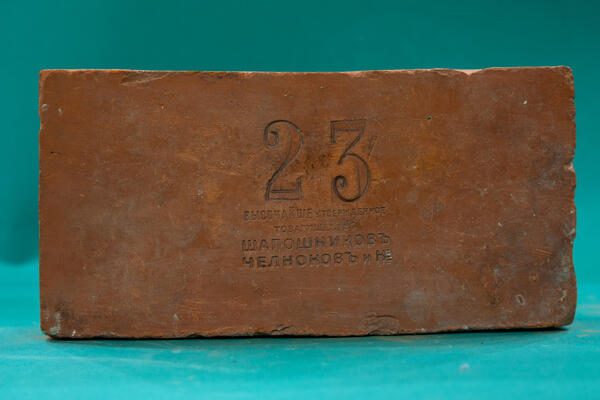
Brick with the Brand 23
#11
#12
After the death of Vasily Chelnokov, the founder of the brick factory next to the Sharapovo village near Bolshie Mytishchi, his five children inherited the factory. In 1887, an agreement was signed between the four sons and the daughter Elena, according to which the brothers Sergei, Mikhail, Vasily, and Fyodor got 50 desyatinas (approx. 0.21 sq. miles) of land. At the time, the Mytishchi factory produced six million bricks a year with a total cost of 120,000 rubles. The factory employed 310 workers.
On January 1, 1887, a trading house was established as a full partnership ‘V. K. Shaposhnikov and M. V. Chelnokov’. The Partneship for manufacture and sale of construction materials ‘V. K. Shaposhnikov, M. V. Chelnokov and C°’ incorporated all the Moscow trading houses of Chelnokov’s inheritors. Since then, all brick were branded with the mark “Imperially Established Partnership Shaposhnikov, Chelnokov, and C°”.
Inheritors were still engaged in brick manufacture and sales. They upgraded their equipment which helped them increase overall output with less hired staff. By 1894, the factory produced 8 million bricks a year with a total cost of 160,000 rubles with only 204 workers. The Chelnokov also purchased land, and in the end in 1905 they had “209 desyatinas (0.88 sq. miles) in property and rented 41 desyatinas (0.172 sq. miles) from peasants)”.
The range of construction materials produced by the Partnership was huge. According to the 1905 “List of Joint-Stock Companies and Trading Houses Operating in the Empire, ” “Since the day of its establishment, the Partnership For Manufacture and Sales of Construction Materials 'V. K. Shaposhnikov, M. V. Chelnokov and Co' took measures to grow which resulted in an increased output, purchase of new lands, purchase of new production machinery… The Partnership produced bricks, lime, Roman cement, rubble, and peat at their own factories located in the Moscow Governorate. The goods produced at the factories are sold mostly in the Moscow and adjacent Governorates: Smolensk, Yaroslavl, Nizhny Novgorod, Vladimir, and Kostroma Governorates.” Many buildings in Moscow and other cities of Russia were made form bricks produced at the Mytishchi factory.
On January 1, 1887, a trading house was established as a full partnership ‘V. K. Shaposhnikov and M. V. Chelnokov’. The Partneship for manufacture and sale of construction materials ‘V. K. Shaposhnikov, M. V. Chelnokov and C°’ incorporated all the Moscow trading houses of Chelnokov’s inheritors. Since then, all brick were branded with the mark “Imperially Established Partnership Shaposhnikov, Chelnokov, and C°”.
Inheritors were still engaged in brick manufacture and sales. They upgraded their equipment which helped them increase overall output with less hired staff. By 1894, the factory produced 8 million bricks a year with a total cost of 160,000 rubles with only 204 workers. The Chelnokov also purchased land, and in the end in 1905 they had “209 desyatinas (0.88 sq. miles) in property and rented 41 desyatinas (0.172 sq. miles) from peasants)”.
The range of construction materials produced by the Partnership was huge. According to the 1905 “List of Joint-Stock Companies and Trading Houses Operating in the Empire, ” “Since the day of its establishment, the Partnership For Manufacture and Sales of Construction Materials 'V. K. Shaposhnikov, M. V. Chelnokov and Co' took measures to grow which resulted in an increased output, purchase of new lands, purchase of new production machinery… The Partnership produced bricks, lime, Roman cement, rubble, and peat at their own factories located in the Moscow Governorate. The goods produced at the factories are sold mostly in the Moscow and adjacent Governorates: Smolensk, Yaroslavl, Nizhny Novgorod, Vladimir, and Kostroma Governorates.” Many buildings in Moscow and other cities of Russia were made form bricks produced at the Mytishchi factory.
#13
Date: early 20th century
Dimensions: 26×13×7 cm
Technique: clay, baking, molding
Place: Mytishchi
Collection: Glass, Ceramics, Porcelain
Copyright: Municipal Budget Cultural Institution “Mytishchi History and Art Museum”
Goskatalog Number: 21825751
Dimensions: 26×13×7 cm
Technique: clay, baking, molding
Place: Mytishchi
Collection: Glass, Ceramics, Porcelain
Copyright: Municipal Budget Cultural Institution “Mytishchi History and Art Museum”
Goskatalog Number: 21825751
#14
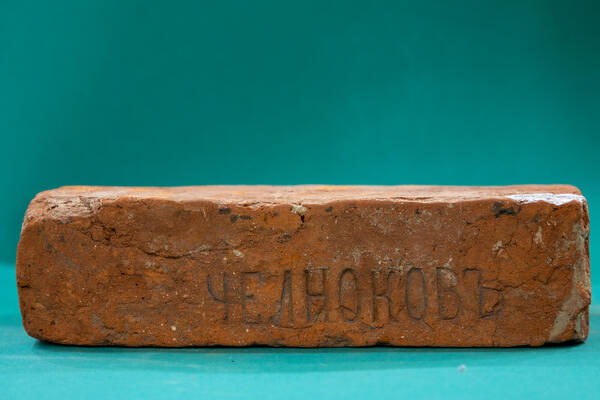
Brick with the Brand Chelnokov
#15
#16
The Chelnokovs were an old family of merchants. The Chelnokov brothers, Second-Guild Moscow merchants, honorary citizens, lived in Moscow around the 1850s.
Vasily Chelnokov, who established his own brick factory in Sharapovo, near Bolshie Mytishchi, became a major manufacturer in 1869. At first, the merchant rented land from the peasants' union and then purchased it. The fact of purchasing was recorded in the land register of the Moscow Notary Archive. Chelnokov’s factory was standing on a field with spots of marshland. The soil on the lot he bought was rich in clay: It was of uneven color, reddish and dark brown, very greasy, too hard for the crushing machine, and contained a lot of iron and organics. The factory used it in production of bricks of all types: salmon, red, and second-class bricks.
Initially, Chelnokov had three Russian stoves for baking bricks. Workers used long iron tongs to take bricks out of them. By 1880, the factory purchased the advanced Hoffman circular kiln.
Chelnokov financed the construction of the railroad from Mytishchi station with his own funds. Steadily, the factory was growing. By 1880, new buildings for workers were finished, including seven residential houses (dormitories, kitchens, canteens), a sauna, and a hospital. The number of brick molding barns reached 50. The bricks were molded using a manual-machine method in lead molds on 140 tables.
There were 260 people working at the factory: bricklayers, dryers, clay diggers, boilers, and kiln workers. Kilns worked all year long, clay was extracted from mid-May to November, and mudbricks were manufactured from May to September. A work day lasted from 11 hours to a minimum of nine hours in winter.
In 1879, Vasily Fyodorovich Chelnokov passed away. His five children (four sons and a daughter) inherited his brick factory. Young factory owned introduced the new brand “Chelnokov” to maintain the tradition of their father’s brand ‘V. Chelnokov.’ Both brand marks can be found on the brickwork of late 19th–early 20th century’s buildings.
Several buildings build from the bricks produced at Chelnokov’s factory continue to stand in Mytishchi. These are the pharmacy on Kolontsova Street, the water tower near the railroad, the former school in Bolshie Mytishchi, and the side altar of St. Nicholas the Wonder-Worker at the Vladimir Church. Chelnokov’s bricks were used for construction of the zemstvo (provincial) hospital, the railway station, the pumping station of Mytishchi (Vodokanal), the Viskoza factory, industrial and residential buildings of the Chernyshovs' factory (Proletarskaya Pobeda).
Vasily Chelnokov, who established his own brick factory in Sharapovo, near Bolshie Mytishchi, became a major manufacturer in 1869. At first, the merchant rented land from the peasants' union and then purchased it. The fact of purchasing was recorded in the land register of the Moscow Notary Archive. Chelnokov’s factory was standing on a field with spots of marshland. The soil on the lot he bought was rich in clay: It was of uneven color, reddish and dark brown, very greasy, too hard for the crushing machine, and contained a lot of iron and organics. The factory used it in production of bricks of all types: salmon, red, and second-class bricks.
Initially, Chelnokov had three Russian stoves for baking bricks. Workers used long iron tongs to take bricks out of them. By 1880, the factory purchased the advanced Hoffman circular kiln.
Chelnokov financed the construction of the railroad from Mytishchi station with his own funds. Steadily, the factory was growing. By 1880, new buildings for workers were finished, including seven residential houses (dormitories, kitchens, canteens), a sauna, and a hospital. The number of brick molding barns reached 50. The bricks were molded using a manual-machine method in lead molds on 140 tables.
There were 260 people working at the factory: bricklayers, dryers, clay diggers, boilers, and kiln workers. Kilns worked all year long, clay was extracted from mid-May to November, and mudbricks were manufactured from May to September. A work day lasted from 11 hours to a minimum of nine hours in winter.
In 1879, Vasily Fyodorovich Chelnokov passed away. His five children (four sons and a daughter) inherited his brick factory. Young factory owned introduced the new brand “Chelnokov” to maintain the tradition of their father’s brand ‘V. Chelnokov.’ Both brand marks can be found on the brickwork of late 19th–early 20th century’s buildings.
Several buildings build from the bricks produced at Chelnokov’s factory continue to stand in Mytishchi. These are the pharmacy on Kolontsova Street, the water tower near the railroad, the former school in Bolshie Mytishchi, and the side altar of St. Nicholas the Wonder-Worker at the Vladimir Church. Chelnokov’s bricks were used for construction of the zemstvo (provincial) hospital, the railway station, the pumping station of Mytishchi (Vodokanal), the Viskoza factory, industrial and residential buildings of the Chernyshovs' factory (Proletarskaya Pobeda).
#17
Date: early 20th century
Technique: clay, baking, molding
Dimensions: 27×13×7,5 cm
Copyright: Municipal Budget Cultural Institution “Mytishchi History and Art Museum”
Collection: Glass, Ceramics, Porcelain
Goskatalog Number: 21825842
Technique: clay, baking, molding
Dimensions: 27×13×7,5 cm
Copyright: Municipal Budget Cultural Institution “Mytishchi History and Art Museum”
Collection: Glass, Ceramics, Porcelain
Goskatalog Number: 21825842
#18
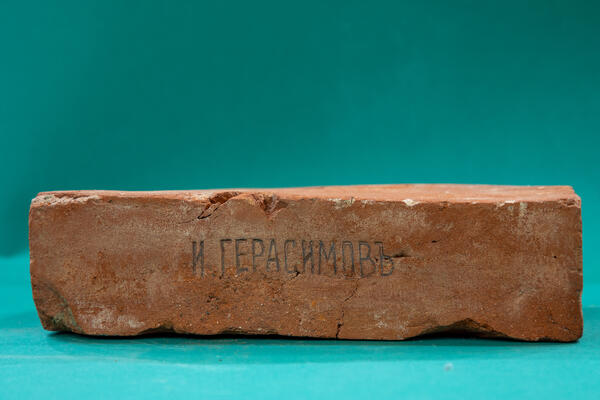
Brick with the Brand I. Gerasimov
#19
#20
Moscow resident Ivan Gerasimov never had his own land to extract clay. Nevertheless, for 30 year he ran a large and successful brick factory. He took part in brick production of the famous Moscow company of the Gusarevs and was their authorized agent. In the late 1880s Gusarev’s widow closed down the factory, and Ivan Gerasimov managed to put his expertise to use in Mytishchi.
In 1888, the Department of Land send an order to the manager of the Moscow Land Office to “rent out a land lot of 22 quarters in Mytishchi to Ivan Gerasimovich Gerasimov for him to start a brick factory and a clay and sand extraction facility, for 24 years, the cost of the forest growing on this lot paid…”
However, Gerasimov managed to start building his factory only after six months of tiresome disputes with the Chelnokov brothers over the rented land. Very soon, the factory and the access railroad from Mytishchi to the kiln were finished. He put the brand mark “I. Gerasimov” on the stretcher face (the long side) of each brick.
The assessment book of 1912 helped determine the “property value” of the Moscow merchant Ivan Gerasimov’s brick factory. It could match the cost of the factory owned by the major Partnership of V. K. Shaposhnikov, M. V. Chelnokov and Co and was valued at almost two times less the cost. However, by terms of Moscow, Gerasimov’s factory was rather big. Still, compared to other factories in Mytishchi it produced less bricks than, for example, Chelnokov’s and Voronin’s factories.
Just before the start of World War One, Gerasimov’s factory had an annual turnover of 150,000 rubles, with 160 people engaged in production. Bricks were molded manually. In March 1917, the architect Kurt Betge who supervised the construction of the factory of self-propelled vehicles in Podlipki that used bricks supplied by the Mytishchi factories, noticed the following:
In 1888, the Department of Land send an order to the manager of the Moscow Land Office to “rent out a land lot of 22 quarters in Mytishchi to Ivan Gerasimovich Gerasimov for him to start a brick factory and a clay and sand extraction facility, for 24 years, the cost of the forest growing on this lot paid…”
However, Gerasimov managed to start building his factory only after six months of tiresome disputes with the Chelnokov brothers over the rented land. Very soon, the factory and the access railroad from Mytishchi to the kiln were finished. He put the brand mark “I. Gerasimov” on the stretcher face (the long side) of each brick.
The assessment book of 1912 helped determine the “property value” of the Moscow merchant Ivan Gerasimov’s brick factory. It could match the cost of the factory owned by the major Partnership of V. K. Shaposhnikov, M. V. Chelnokov and Co and was valued at almost two times less the cost. However, by terms of Moscow, Gerasimov’s factory was rather big. Still, compared to other factories in Mytishchi it produced less bricks than, for example, Chelnokov’s and Voronin’s factories.
Just before the start of World War One, Gerasimov’s factory had an annual turnover of 150,000 rubles, with 160 people engaged in production. Bricks were molded manually. In March 1917, the architect Kurt Betge who supervised the construction of the factory of self-propelled vehicles in Podlipki that used bricks supplied by the Mytishchi factories, noticed the following:
‘We are currently evaluating red bricks. Turns out, Gerasimov’s bricks are the best we can get now; the bricks by Shaposhnikov and Chelnokov from Rostokino are of average quality’.
In 1916, Ivan Gerasimov passed away. His son Ivan Ivanovich Gerasimov followed in his father’s foosteps. The early 1917 was marked by reorganization of administrative institutions, private land was nationalized. A new life began, and there was no place in it for factory owners.
#21
Dimensions: 27×12,5×7 cm
Technique: clay, baking, molding
Date: early 20th century
Place: Mytishchi
Collection: Glass, Ceramics, Porcelain
Technique: clay, baking, molding
Date: early 20th century
Place: Mytishchi
Collection: Glass, Ceramics, Porcelain
Copyright: Municipal Budget Cultural Institution ‘Mytishchi History and Art Museum’
Goskatalog Number: 21825820
Goskatalog Number: 21825820
#22
Municipal Budget Cultural Institution “Mytishchi History and Art Museum”
read morehide
00:00
00:00
1x
1
 Point your smartphone camera to open in the app
Open in app
Share